What is Attar? The Complete Beginner’s Guide
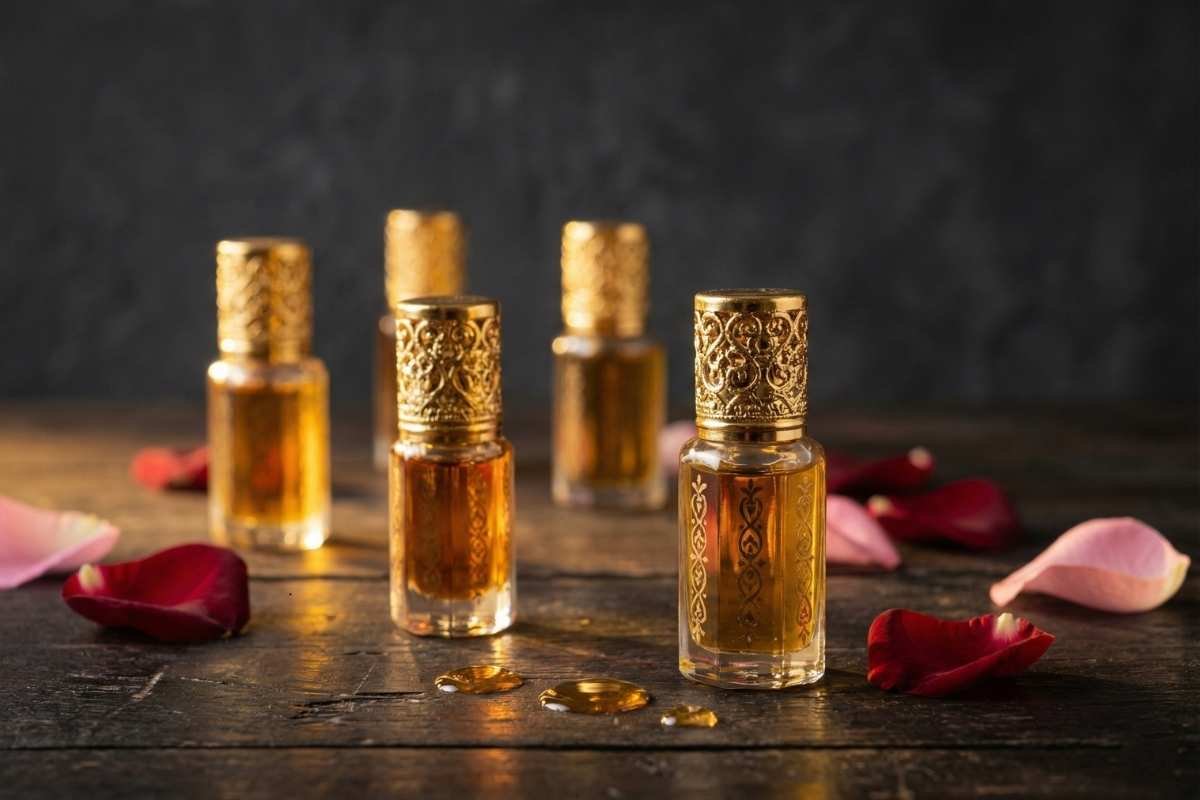
I was maybe 14 or 15 when I first smelled it.
A family wedding. One of those big, chaotic Indian weddings where you don’t even know half the people. I was sitting somewhere near the back, probably bored, probably on my phone — and this older relative sat down next to me.
I don’t remember what he said. I don’t remember his face clearly. But I remember the scent.
It wasn’t cologne. It wasn’t one of those sharp, alcohol-heavy sprays that hit you from three feet away and disappear in an hour.
This was different. It was warm. Deep. Almost alive on his skin, like it was part of him, not just sitting on top of his clothes.
I remember thinking — what IS that?
I didn’t ask. You don’t ask things like that when you’re 15. But that scent stayed with me. Not in a poetic way. In a very literal way. I could still catch faint traces of it on my own kurta when I got home that night.
Years later, I found out what it was. It was attar.
And here’s the thing, most of us in India have a version of this memory.
A grandmother’s cupboard that smelled a certain way. A tiny ornate bottle at a relative’s house. A whiff of something deep and floral at a dargah or a temple. We grow up around attars without ever actually understanding what they are.
This guide is everything I wish someone had told me when I first got curious.
What attar actually is, how it’s made, why it smells the way it does, why it’s completely different from every perfume on your shelf right now, and how to tell the real stuff from the fakes.
Let’s get into it.
Table of Contents
- 1. What is Attar, Really?
- 2. Where Did Attar Come From? A Short History
- 3. How is Attar Made? The Ancient Art of Deg-Bhapka
- 4. Types of Attar: A Complete Breakdown
- 5. Attar vs Perfume vs Essential Oil — What’s the Actual Difference?
- 6. How to Wear Attar the Right Way
- 7. How to Tell if an Attar is Real or Fake
- One Last Thing
- FAQs
1. What is Attar, Really?
Let’s start with the simplest possible answer.
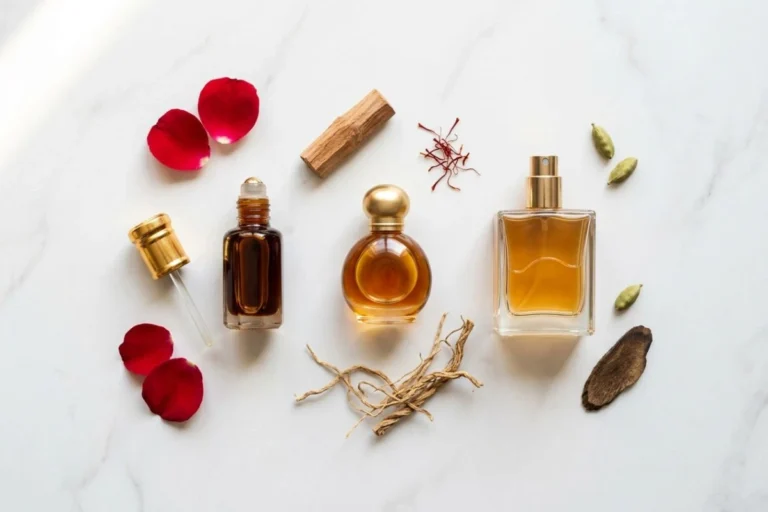
Attar, also spelled ittar, is a natural perfume oil. It’s made from botanical sources like flowers, herbs, spices, wood, and in some cases, even baked earth. These raw materials are distilled using an ancient process called hydro-distillation, and the resulting fragrant oil is captured in a base of sandalwood oil.
That’s what attar is at its core. But that one-line definition doesn’t tell you why attar is so different from everything else in the fragrance world.
So let me break it down.
The Word Itself
“Attar” comes from the Arabic word “itr” (عطر), which simply means fragrance or scent. Some trace it further back to the Persian word “atr.”
If you’ve heard your grandparents use the Hindi word “itra” — same thing. Same root.
The word has been traveling through languages and cultures for centuries, just like the scent itself.
What Makes Attar Different from Regular Perfume
Three things:
- It’s oil-based, not alcohol-based. Modern perfumes use alcohol as a carrier. That’s why they hit you hard when first sprayed and then fade within hours — the alcohol evaporates fast and takes most of the scent with it. Attar doesn’t have this problem. Oil evaporates much more slowly. Your body heat releases the fragrance gradually, which is why a single dab of attar can last anywhere from 6 to 12 hours on your skin.
- The sandalwood base isn’t random. Traditional attars are distilled into sandalwood oil because sandalwood is a natural fixative — it holds onto volatile flower essences that would otherwise vanish within hours. It’s the reason attar has that depth, that warmth underneath whatever the main scent is. Even when you’re wearing rose attar, there’s always that subtle, creamy sandalwood anchor holding everything together.
- There’s nothing synthetic in a true attar. No lab-created molecules. No chemical preservatives. No artificial anything. Just plant material, water, fire, copper, and sandalwood oil. That’s the entire ingredient list.
Attar vs Ruh — What’s the Difference?
You’ll sometimes see the word “Ruh” — like Ruh Gulab (rose) or Ruh Khus (vetiver). These are related to attars but not the same thing.
Here’s the difference:
- Attar = fragrant oil distilled INTO a sandalwood oil base
- Ruh = the pure essential oil of a plant, extracted through distillation, WITHOUT any sandalwood base
Think of Ruh as the raw, undiluted spirit of the flower. Attar has the sandalwood foundation. Ruh doesn’t.
Both are natural, both are traditional — but they’re different products, and it’s worth knowing the distinction early on.
One More Thing Before We Move On
Not every bottle labeled “attar” is actually attar.
The market is flooded with synthetic fragrance oils — sometimes called CPOs (Concentrated Perfume Oils) — that borrow the name but share nothing with the real thing.
They can smell fine, but they’re not attar. I’ll cover exactly how to spot the difference later in this guide.
For now, just know this: real attar is handmade, oil-based, naturally distilled, and has been made the same way for hundreds of years.
And the story of how it’s made? That’s worth its own section.
2. Where Did Attar Come From? A Short History
Attar isn’t something someone invented in a lab fifty years ago.
It’s one of the oldest forms of perfumery on the planet — and its history is tangled up with empires, poets, queens, and centuries of obsession with capturing the smell of flowers in a bottle.
Here’s how it all unfolded.
Ancient Roots
The earliest references to fragrant oils in India go back thousands of years.
The Charaka Samhita — one of the foundational texts of Ayurveda — mentions the use of aromatic oils. The Harshacharita, written in 7th century AD, specifically references fragrant agarwood oil.
And the Brhatsamhita, a 6th century Sanskrit encyclopedia, contains detailed references to perfumes and cosmetics.
But India wasn’t the only place working with fragrance.
Ancient Egyptians were producing perfumes from plants and flowers long before distillation was even a concept. Early perfumes everywhere were essentially the same idea — soak flowers or herbs in oil or water, let the scent infuse, remove the plant material, and use what’s left.
The problem? These methods were crude. The scents were faint, inconsistent, and didn’t last.
Everything changed with distillation.
The Breakthrough — Ibn Sina and the Art of Distillation
The Persian physician Ibn Sina (also known as Avicenna), working around the 10th-11th century, is widely credited with refining the distillation process for extracting flower essences.
He was among the first to experiment with distilling roses — and what he got was rose water with a thin layer of concentrated oil floating on top.
That oil was, essentially, the ancestor of what we now call attar.
Before Ibn Sina, liquid perfumes were just crushed herbs mixed into oil. His distillation technique made it possible to capture the true essence of a flower — concentrated, pure, and far more potent than anything that came before.
Later, Ibn al-Baitar (1197–1248), a physician and pharmacist from Muslim Spain, documented these essential oil techniques in even greater detail, helping spread the knowledge across the Islamic world and beyond.
The Mughal Golden Age — When Attar Became Royalty
This is where the story gets really good.
When the Mughals ruled India, attar wasn’t just a fragrance — it was a symbol of power, sophistication, and romance. And the royal courts were absolutely obsessed with it.
A few stories worth knowing:
- Akbar had an entire perfume department. His historian Abul Fazl documented it in the Ain-e-Akbari — Akbar used attar daily and burned incense (bakhoor) in gold and silver censers. A princess’s bath was considered incomplete without incense and attar.
- Noor Jahan, wife of Emperor Jahangir, is credited with discovering Rooh Gulab — rose attar. The legend goes that she noticed a thin, oily film floating on the surface of rose water in her bath. That film turned out to be the concentrated essence of rose. She didn’t just notice it — she recognized what it was. That discovery changed Indian perfumery forever.
- Shah Jahan is associated with the creation of Shamama attar — one of the most complex fragrances ever made (more on that later).
- Jasmine attar was the signature scent of the Nizams of Hyderabad — they were known for it the way a modern celebrity might be known for a particular brand.
- And then there’s Mirza Ghalib, the legendary Urdu poet. Historical accounts say he would rub hina attar on his hands and face before meeting his beloved in winter. Attar wasn’t just something he wore — it was part of how he loved.
These aren’t just fun historical facts. They tell you something important about what attar meant in Indian culture.
It wasn’t a product. It wasn’t a “lifestyle accessory.” It was woven into how people expressed devotion, power, beauty, and intimacy.
Kannauj — India’s Perfume Capital
All of this history converges in one small city in Uttar Pradesh: Kannauj.
Kannauj has been crafting attars for over 400 years. To put that in perspective, that’s more than two centuries before Grasse, France became famous as Europe’s perfume capital.
People sometimes call Kannauj “India’s Grasse,” but honestly, the history runs the other way around.
A few things that make Kannauj remarkable:
- It’s home to hundreds of distilleries, many still using the exact same techniques from centuries ago
- Some of these distilleries are run by families that have been making attar for 6, 7, even 30 generations
- In Kannauj, nearly every other household is connected to the attar trade in some way — from flower farmers to clay-pot makers to export vendors
- Kannauj Perfume received a GI (Geographical Indication) tag in 2014, officially recognizing its unique cultural and artisanal value
- The city sits along the Ganges, and the alluvial soil in the region produces some of the finest Damask roses in India — the key ingredient for rose attar
But it’s not all good news.
The traditional attar trade is under pressure. Cheaper synthetic alternatives have flooded the market. Many families have had to shut down their distilleries or pivot to making imitation Western perfumes just to survive.
The craft is alive, but it’s fighting to stay that way.
The Spiritual Thread
Attar has never been just about smelling good. Across cultures and religions, it has always carried a deeper meaning:
- In Islam, attars are the preferred fragrance because they’re alcohol-free. They hold deep significance in Sufi spiritual practice — saints and spiritual aspirants would anoint themselves with attar to aid meditation and inner journeys. Attar is also commonly worn before Friday prayers and during festivals like Eid.
- In Hinduism, attars have been used in temple worship and deity offerings for centuries. Fragrant oils are part of the ritual fabric.
- In Ayurveda, certain attars are believed to have therapeutic properties — balancing doshas, calming the mind, even influencing body temperature (which is why there’s a whole warm/cool classification system for attars, which I’ll cover later).
The point is, attar was never just a beauty product. It was medicine, devotion, romance, and identity, all held in a tiny bottle.
And the way it’s made has barely changed in 400 years. That process — ancient, painstaking, and almost unbelievable in its simplicity — deserves its own deep dive.
3. How is Attar Made? The Ancient Art of Deg-Bhapka
If you’ve read this far, you know what attar is and where it came from. Now let me show you how it’s actually made, because this is where it gets fascinating.
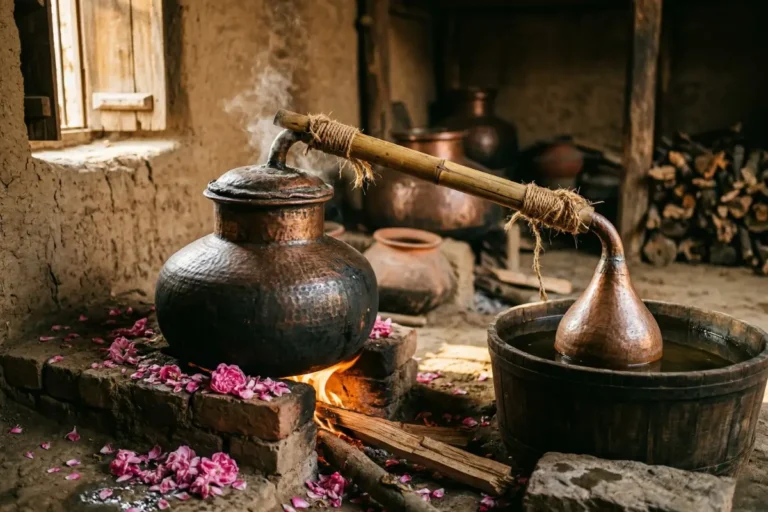
The traditional method of making attar is called deg-bhapka. It’s a hydro-distillation technique that’s been used in Kannauj for centuries.
And when I say traditional, I mean it.
We’re talking copper vessels, open fires, bamboo pipes, clay seals, and zero electricity. No machines. No thermostats. No digital gauges.
Just a man, his hands, his ears, and generations of knowledge.
Here’s the short version of how it works.
Flowers are picked before sunrise, when their aromatic oils are at peak concentration, and rushed to the distillery the same morning.
They go into a large copper pot called a deg, along with water. The deg is sealed shut with a paste of wet clay and cotton, then heated over a wood fire.
As the water heats up, fragrant steam rises and travels through a bamboo pipe into a second copper vessel called a bhapka.
And here’s the critical part. The bhapka already contains sandalwood oil. The steam condenses, and the flower essence merges with the sandalwood, drop by drop, hour by hour.
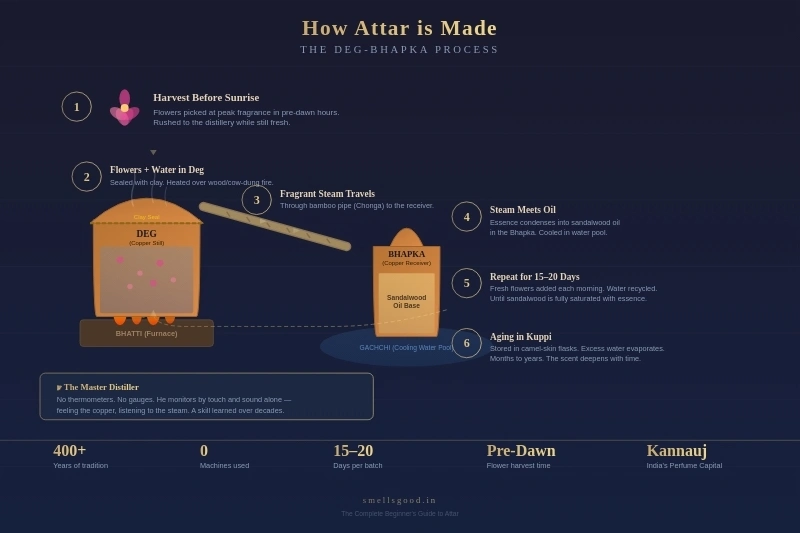
There are no thermometers or gauges anywhere in this process. A master distiller monitors everything by touching the hot copper with his bare hands and listening to the sounds of the steam. Skills that take a decade of apprenticeship to learn.
And one day of this isn’t enough.
The cycle repeats with fresh flowers every single day for 15 to 20 days, until the sandalwood oil is completely saturated with the flower’s essence. After that, the attar is aged in leather flasks, sometimes for years, before anyone considers it ready.
That’s why real attar costs what it costs. Weeks of fire, flowers, and human judgment, all for a tiny bottle.
I’ve written a complete guide on how attar is made that covers the full process step by step, the science behind why it works, the sandalwood crisis, and why this craft is fighting to survive. If this section pulled you in, that guide is the deep dive.
4. Types of Attar: A Complete Breakdown
One of the first things that surprises beginners about attar is just how wide the world is.
This isn’t like walking into a perfume store where everything is some variation of “fresh” or “woody.” Attars range from the scent of roses to the smell of rain-soaked earth, from single-flower extracts to compounds made with 60+ ingredients that take months to produce.
Let me walk you through all of it.
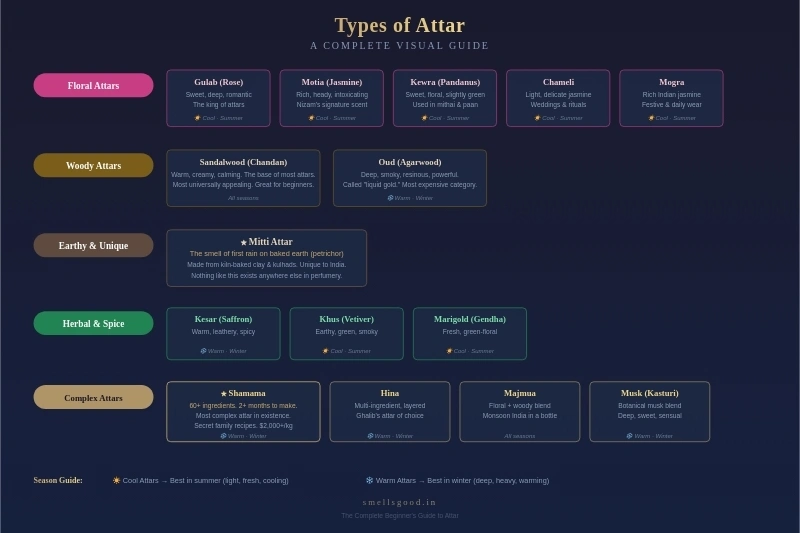
By Source — What The Attar Is Made From
This is the most straightforward way to understand attars. What went into the deg determines what comes out.
Floral Attars (single flower)
These are the most well-known and the easiest starting point for beginners. Each one is made from a single species of flower, distilled into sandalwood oil.
- Gulab (Rose) Attar — The king of attars. Made from Rosa damascena petals — the Damask rose. Sweet, deep, unmistakably romantic. Kannauj roses, grown in the alluvial soil along the Ganges, are considered some of the finest in the world for attar production. If attar had a flagship scent, this is it.
- Motia (Jasmine) Attar — Rich, sweet, heady, almost intoxicating. This was the signature fragrance of the Nizams of Hyderabad. The scent is often associated with the deep forests of the lower Himalayas. One of those attars that fills a room even from a single dab.
- Chameli Attar — Also jasmine, but a different variety — lighter, more delicate than motia. Popular in weddings and religious ceremonies. If motia is a shout, chameli is a whisper.
- Kewra (Pandanus) Attar — Sweet, floral, with a slightly green edge. The kewra plant grows wild along India’s east coast, with the best quality coming from the Ganjam district of Odisha. You’ve probably encountered kewra without knowing it — it’s widely used to flavor Indian sweets (mithai) and paan.
- Mogra Attar — Indian jasmine. Rich, sweet, deeply floral. A favorite in cultural celebrations and festive occasions. Soft enough for daily wear but complex enough to keep you noticing new things hours later.
Earthy and Unique Attars
This is where Indian attar tradition gets truly one-of-a-kind.
- Mitti Attar — If I had to pick one attar that captures the soul of India, it would be this one. Mitti attar is the smell of baked earth after the first monsoon rain — what scientists call petrichor. It’s made by taking kiln-baked clay discs and discarded kulhads (those little clay tea cups you see everywhere) and distilling them into sandalwood oil. The process takes 10+ days, just like floral attars. The result is something that exists nowhere else in the world of fragrance. Not in French perfumery. Not in Middle Eastern oud culture. Nowhere. It smells like memory itself — monsoon afternoons, wet soil, childhood. If you’ve never experienced mitti attar, put it on your list. It’ll change how you think about what a “perfume” can be.
Woody Attars
- Sandalwood (Chandan) Attar — Warm, creamy, smooth, calming. Sandalwood is already the base of most other attars, but it’s also worn on its own. It’s the most universally appealing attar — rarely offends anyone, works in every season, and has a meditative quality that’s hard to describe until you’ve worn it for a full day.
- Oud (Agarwood) Attar — Deep. Smoky. Resinous. Powerful. Oud is extracted from the fungus-infected heartwood of Aquilaria trees — the wood produces a dark, aromatic resin as a defense mechanism against the infection, and that resin is what gives oud its extraordinary scent. Oud is often called “liquid gold” — partly because of its scent, partly because of its price. It’s the heart of Arabic perfumery and one of the most prized fragrance ingredients on the planet. Not a beginner attar. But once you’re ready for it, there’s nothing else like it.
Herbal and Spice Attars
- Kesar (Saffron) Attar — Warm, leathery, spicy with a subtle sweetness. A winter attar through and through.
- Marigold (Gendha) Attar — Fresh, green-floral, distinctly Indian. Less common than the floral attars but deeply refreshing.
- Khus (Vetiver) Attar — Earthy, green, slightly smoky. Made from the roots of vetiver grass. A grounding, calming scent often associated with summer.
Complex / Compound Attars — The advanced level
This is where attar-making goes from craft to art form. These aren’t single-ingredient attars — they’re elaborate compositions made from dozens of materials, distilled in stages, over weeks or months.
- Shamama Attar — The most complex attar in existence. Shamama is distilled from a compound of 60 or more aromatic materials — woods, moss, cloves, ambrette seed, saffron, sandalwood, valerian, spikenard, charila (a Himalayan lichen), cardamom, juniper berry, nutmeg, and more. The recipe varies from family to family and is closely guarded — passed down through generations, never written down in full. The distillation itself happens in multiple stages over two or more months. The first stage might be a 10-day distillation of charila into sandalwood. The second stage adds roasted aromatic plants and roots. Then more layers. Then aging. The result is a fragrance of extraordinary depth — bitter and medicinal on top, rich and ambery in the heart, mossy and earthy at the base, with animalic facets that shift and evolve over hours on the skin. Traditionally-distilled shamama starts at $2,000+ per kilo. Most shamama available today is a blend of naturals and synthetics, which can still smell surprisingly good, but it’s worth knowing the difference.
- Hina Attar — Another complex, multi-ingredient attar. Often confused with shamama, but a different formulation. This is the attar Mirza Ghalib was known to wear. Deep, warm, layered — built for cold winter evenings.
- Majmua Attar — A harmonious blend of multiple floral and woody ingredients. The scent is designed to evoke the lush, earthy feeling of India during monsoon season. Powerful stuff — potentially overwhelming if you’re not used to it. Diluting in a carrier oil before wearing is not a bad idea.
- Musk (Kasturi) Attar — Despite the name, most musk attars today don’t contain actual deer musk (hunting musk deer is illegal in India). Instead, they’re complex botanical compositions designed to recreate that deep, sweet, sensual musk character using plant-based ingredients.
By Effect On The Body — The Warm and Cool System
This is a classification system that’s uniquely Indian, and it tells you something important about how attar culture thinks about fragrance.
In the Western perfume world, you pick a scent based on whether you like how it smells. In Indian attar tradition, there’s an additional layer — how the scent interacts with your body and the season.
Warm Attars (for winter and cold weather)
- Musk, Amber, Kesar (Saffron), Oud
- Believed to increase body warmth
- Deep, heavy, enveloping scents
- Wearing these in summer can feel overwhelming and oppressive
Cool Attars (for summer and hot weather)
- Rose, Jasmine, Khus (Vetiver), Kewra, Mogra
- Believed to cool the body
- Light, fresh, breezy scents
- Wearing these in winter feels too thin, too fleeting
This isn’t just folk wisdom. There’s a practical logic to it — heavier oil-based fragrances feel suffocating in heat, while lighter florals get lost in cold air. Indian attar culture figured this out centuries ago and built an entire classification system around it.
If you take one thing from this section, let it be this: match your attar to the season. It genuinely makes a difference.
5. Attar vs Perfume vs Essential Oil — What’s the Actual Difference?
This is probably the most common question people have when they first discover attars.
And honestly, it’s a fair question — all three come from plants, all three smell good, and all three come in small bottles. So what’s the actual difference?
More than you’d think.
The quick comparison
| Attar | Modern Perfume | Essential Oil | |
|---|---|---|---|
| Base | Sandalwood oil | Alcohol + water | None (pure extract) |
| Ingredients | 100% natural botanicals | Natural + synthetic blend | Single plant extract |
| Alcohol | No | Yes (60–90%) | No |
| How it’s made | Hydro-distillation (deg-bhapka) | Industrial blending | Steam distillation or cold press |
| Lasts on skin | 6–12 hours | 4–8 hours | 1–3 hours |
| How you apply it | Dab directly on skin | Spray on skin/clothes | Dilute in carrier oil first |
| Primary use | Personal fragrance, spiritual | Personal fragrance, fashion | Aromatherapy, therapeutic |
| Shelf life | Virtually permanent (improves with age) | 3–5 years | 1–3 years |
That table gives you the snapshot. But the real understanding comes from knowing why these differences exist.
Why Attar Lasts So Much Longer Than Perfume
This isn’t some mysterious quality. It’s basic chemistry.
Modern perfumes use alcohol as a carrier — typically 60–90% of what’s in that bottle is alcohol.
When you spray a perfume, the alcohol evaporates fast. That’s what gives you that initial burst of scent.
But as the alcohol disappears, it takes a big chunk of the fragrance with it. By hour four or five, you’re often left with a faint trace of what you started with.
Attar uses oil as a carrier. Oil doesn’t evaporate the way alcohol does. Instead, your body heat acts like a slow-release mechanism — it warms the oil just enough to project the scent steadily, without burning it off. That’s why a single dab of attar at 8 AM can still be noticeable at 10 PM.
It’s not that attar is “better” in some abstract way. It’s that oil and alcohol behave differently on your skin, and that difference changes everything about the fragrance experience.
Why Attar Smells Different On Every Person
This is something that catches first-time attar users off guard.
You borrow a friend’s attar, apply it the same way, and it smells completely different on you. That’s not a defect — it’s actually one of the most interesting things about oil-based fragrances.
Because attar sits directly on your skin (no alcohol barrier), it interacts with your body chemistry in a way that spray perfumes don’t. Your skin’s pH, your diet, the natural bacteria on your skin, even your body temperature — all of these subtly alter how the attar expresses itself.
This is why attar is often called the most personal form of fragrance. The same bottle creates a slightly different scent on every person who wears it. It becomes yours in a way that a spray perfume never quite does.
Where Essential Oils Fit In
Essential oils often get lumped together with attars, but they serve a fundamentally different purpose.
- Essential oils are pure, concentrated plant extracts — the “essence” of a single plant. Lavender oil, tea tree oil, peppermint oil. They’re extracted through steam distillation or cold pressing, and they’re extremely potent.
- Their primary use is therapeutic, not fragrance. Aromatherapy, skincare, stress relief, natural cleaning products. Some people do use them as personal fragrance, but most essential oils are too concentrated to apply directly on skin without diluting in a carrier oil first.
- They also don’t last long as a fragrance. Because there’s no base oil holding them in place (like sandalwood in attars) and no alcohol providing an initial burst (like perfumes), essential oils tend to fade within 1–3 hours on skin.
Think of it this way:
- Essential oil = the raw extract. Therapeutic. Potent. Needs dilution.
- Attar = that raw extract married to a sandalwood base. Designed to be worn. Lasts all day.
- Perfume = a blend of natural and synthetic ingredients in an alcohol base. Designed for mass appeal and convenience.
The “Perfume Oil” Confusion
One last thing worth clearing up.
You’ll see a lot of products online marketed as “attar” or “perfume oil” or “fragrance oil” — and these terms get used interchangeably, which creates a lot of confusion.
Here’s the reality:
- True attar = naturally distilled, sandalwood base, traditional process
- Perfume oil / CPO (Concentrated Perfume Oil) = usually a synthetic or semi-synthetic fragrance blend in an oil base. Alcohol-free, yes. Natural? Not necessarily.
- Fragrance oil = almost always synthetic. Made in a lab.
All three are oil-based. All three are alcohol-free. But only one is attar. The others are different products borrowing a name that doesn’t belong to them.
This matters because when someone tries a cheap “attar” from a random online seller and finds it underwhelming, they’re almost certainly not experiencing real attar. They’re experiencing a synthetic perfume oil with an attar label.
I’ve broken this comparison down even further in a separate guide on attar vs perfume vs EDP if you really want to understand what makes each one tick and which one actually makes sense for you.
6. How to Wear Attar the Right Way
Attar isn’t complicated to use, but it works differently from spray perfume, and a few basics make all the difference.
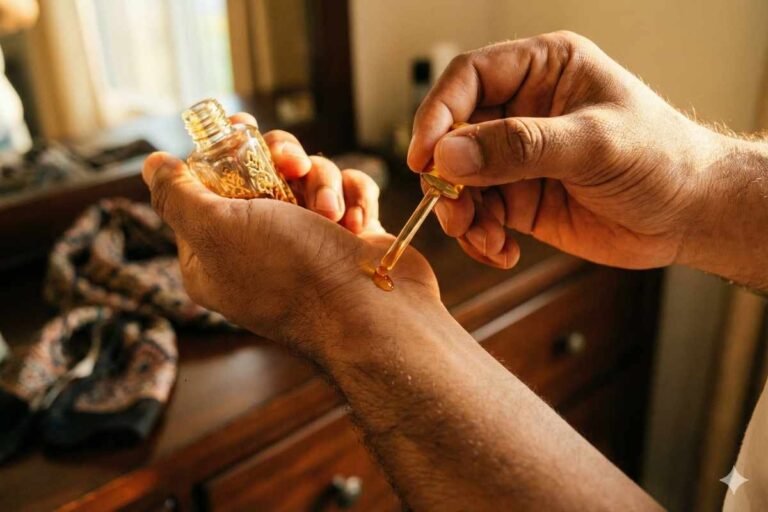
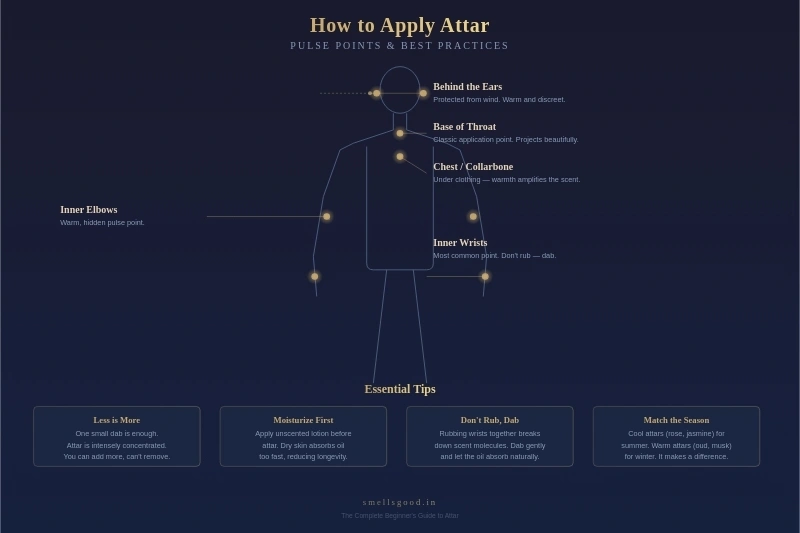
Start with less than you think you need. Attar is intensely concentrated. A single small dab is enough, sometimes even half a dab. You can always add more, but you can’t take it off once it’s on and overpowering everyone around you.
Apply it on pulse points. These are the warm spots where blood vessels sit close to the skin. Inner wrists, sides of the neck, behind the ears. Your body heat slowly releases the fragrance from these spots throughout the day. Two or three spots is plenty.
And the rule almost everyone breaks without realizing: don’t rub.
When you dab attar on your wrists, don’t rub them together. Rubbing breaks down the scent molecules and shortens how long the fragrance lasts. Dab gently and let the oil absorb on its own.
One more thing. Match your attar to the season.
Warm attars like oud and musk for winter, cool ones like rose and khus for summer. It goes back to the warm and cool classification from the types section, and it genuinely changes the experience.
There’s a lot more to this. Moisturizing tricks that double your longevity, applying on clothes without staining them, layering two attars, storage, and how Indian weather changes everything.
I’ve covered all of it in my detailed guide on how to apply attar so it actually lasts all day. Read it once you have your first bottle in hand.
7. How to Tell if an Attar is Real or Fake
This might be the most important section in this entire guide. Because here’s the truth: most of what’s sold as “attar” online isn’t attar at all. It’s a synthetic fragrance oil in a fancy bottle with an Arabic-sounding name.
And if your only experience with attar has been a ₹150 bottle from Amazon that smelled harsh and gave you a headache, you haven’t experienced attar. You’ve experienced a FAKE.
Two checks will protect you from most fakes.
First, the price. Making real attar takes 15 to 20 days of continuous distillation, expensive raw materials, and skilled labor, all for a tiny yield.
The economics create a price floor that no genuine attar can go below. So when you see “pure rose attar” listed for ₹100 to 200 on a marketplace, that’s not rose attar. It can’t be.
Cheap doesn’t mean you found a deal. Cheap means synthetic.
Second, watch how the scent evolves. Real attar is alive on your skin. It changes over hours.
A bright top note when you first apply, something richer in the heart after an hour or two, and a deeper base by evening.
Synthetic fragrance oils smell the same from start to finish. If your “attar” smells identical at 9 AM and 5 PM with no change at all, it’s probably not real attar.
As for where to buy: go directly to Kannauj-based manufacturers where you can, prefer heritage and family-run houses over random marketplace listings with no origin story, and buy samples before committing to a full bottle.
Once you find a seller whose quality you trust, stick with them. That relationship is worth more than any test.
I go much deeper into this in my how attar is made guide, including the texture test, the blotting paper test, and the uncomfortable truth about what most “attar” bases are actually made of today.
One Last Thing
Attar isn’t just a fragrance category you read about and move on. It’s a living tradition — one that’s been passed down through generations of Indian families, artisans, poets, and emperors.
In a world where most of what we spray on ourselves is manufactured in a factory somewhere, mixed from synthetic compounds, and designed to smell like every other bottle on the shelf, attar is something different.
It’s made by hand. From real flowers. Over real fire. By people who learned the craft from their fathers, who learned it from theirs.
When you dab a single drop on your wrist and catch traces of it twelve hours later, warm, evolved, entirely yours, you’re not just wearing a scent.
You’re wearing something that connects you to a 400-year-old tradition that somehow, against all odds, is still alive.
The next time you’re at a family gathering, and you catch that unmistakable warmth from someone’s wrist, you’ll know exactly what it is.
And maybe you’ll want to find your own.
FAQs
Is attar safe for sensitive skin?
Generally, yes. Genuine natural attars are alcohol-free and chemical-free, which makes them significantly gentler than alcohol-based perfumes. Most people with sensitive skin actually do better with attars than with sprays. That said, “natural” doesn’t automatically mean “zero reaction.” Some people can be sensitive to specific botanical ingredients even in their pure form. Oud, for instance, is potent enough that it can occasionally cause irritation on very sensitive skin. The safe approach is to do a small patch test on your inner wrist before applying generously. Wait a couple of hours and if there’s no reaction, you’re good.
How long does attar last on skin?
Anywhere from 6 to 12 hours, depending on the type of attar, its quality, and your skin. Heavier attars like oud and musk tend to last longer than lighter florals like kewra. Genuine, well-aged attar lasts significantly longer than diluted or synthetic alternatives. And oily skin holds fragrance longer than dry skin, which is why moisturizing before application helps. Most people find that a good quality attar easily lasts an entire workday and beyond.
Is attar halal?
Yes. Traditional attars are made entirely from natural botanical ingredients with no alcohol involved at any stage — from distillation to application. This is exactly why attars have been the preferred fragrance in Islamic culture for centuries, and why they’re commonly worn before Friday prayers, during Eid, and in daily life across Muslim communities worldwide.
Why is attar so expensive?
Because everything about making it is slow, manual, and low-yield. Consider rose attar: farmers wake before dawn to pick flowers by hand. Those flowers are loaded into copper stills and distilled over a wood fire for an entire day. The next morning, fresh flowers are added, and the process repeats. This goes on for 15–20 days. The sandalwood oil base itself is expensive. And the final quantity of attar produced from all that effort is relatively small. Add aging time that can range from months to years, the cost of skilled labor, and the price of natural raw materials, and the cost starts making sense. The real question isn’t why attar is expensive. It’s how it could possibly be cheap.
Does attar expire?
No. Genuine attar has virtually no expiry date. In fact, many attars improve with age — the scent deepens, becomes more complex and rounded over time. Some families in Kannauj have attars that are decades old, and they’re considered more precious than fresh batches. The only thing that can degrade an attar is improper storage — direct sunlight, heat, or leaving the bottle unsealed. Store it properly and it’ll outlast the bottle it came in.
Can men and women both wear attar?
Absolutely. Attars are traditionally unisex. The whole concept of “men’s fragrance” and “women’s fragrance” is largely a modern marketing invention — one that attar culture never bought into. In Indian and Middle Eastern tradition, both men and women have always worn rose, jasmine, oud, musk, and everything in between. The choice is based on personal taste, the season, and the occasion — not gender. Wear what you like. That’s the only rule.
What is mitti attar?
Mitti attar is one of the most unique fragrances on the planet. It captures the scent of baked earth after the first monsoon rain — that smell scientists call petrichor. It’s made by distilling kiln-baked clay, including discarded kulhads (those small clay tea cups), into sandalwood oil over a period of 10 or more days. The result is an earthy, soothing fragrance that exists nowhere else in world perfumery. It’s uniquely Indian, and for many people who try it, it becomes the attar they keep coming back to.
What’s the difference between attar and ittar?
Nothing. They’re the same thing — just different spellings. “Attar” is more commonly used in English while “ittar” or “itr” is closer to the original Arabic and Hindi pronunciation. You’ll see both used interchangeably, and they always refer to the same product.
What’s the best attar for beginners?
Sandalwood is the safest starting point — warm, smooth, not overpowering, and almost impossible to dislike. Gulab (rose) attar is another classic first choice — sweet, romantic, familiar enough to feel accessible but deep enough to show you what attar can do. And if you want something completely unlike any fragrance you’ve ever worn, try mitti attar — not floral, not woody, just the earth after rain. It won’t be for everyone, but if it clicks for you, nothing else will compare. Start with one, wear it for a week, and get to know it on your skin. That’s a better introduction than buying five bottles at once.