How to Apply Attar So It Actually Lasts All Day
I’ll be honest with you. When I first started using attars, I had no idea what I was doing.
I just opened the bottle, put way too much on my wrists, rubbed them together, and walked out the door thinking I smelled great.
Turns out I was doing almost everything wrong. And I know I’m not the only one.
Most of us grow up around spray perfumes. You spray it, you walk through it, done. So when you pick up an attar for the first time, you naturally try to use it the same way.
But attar is a completely different thing. It’s pure oil, not alcohol. It doesn’t work the same way, and it definitely doesn’t need the same approach.
The good news is that applying attar the right way is actually really simple once you understand a few basics. And when you get it right, the difference is huge.
Your fragrance lasts longer, it doesn’t overwhelm people around you, and it actually smells the way it’s supposed to on your skin.
That’s what this guide is about.
I’m going to walk you through everything I’ve learned about applying attar. Where to put it, how much to use, what works in Indian summers vs winters, how to put it on your clothes without ruining them, and a bunch of mistakes I made so you don’t have to.
If you’re completely new to attars and still figuring out what they even are, I’d suggest reading my beginner’s guide on what attar is first. It’ll give you the full background.
But if you already have a bottle in your hand and just want to know how to use it properly, you’re in the right place.
Let’s get into it.
Table of Contents
- 1. Why Attar Application Is Different From Spray Perfume
- 2. Before You Apply: Prep Your Skin
- 3. Where to Apply Attar: The Pulse Points
- 4. How to Apply Attar: The Three Methods
- 5. How Much Attar Should You Apply?
- 6. Applying Attar in Indian Weather
- 7. Applying Attar on Clothes
- 8. How to Make Your Attar Last Longer
- 9. Layering Attars: Creating Your Signature Scent
- 10. Common Mistakes to Avoid
- 11. How to Store Your Attar
- Quick Reference: Your Daily Attar Routine
- FAQs
1. Why Attar Application Is Different From Spray Perfume
If you’ve been using spray perfumes your whole life, you need to forget most of what you know before you start with attars.
I’m serious. They look like they do the same job, but the way they work is completely different.
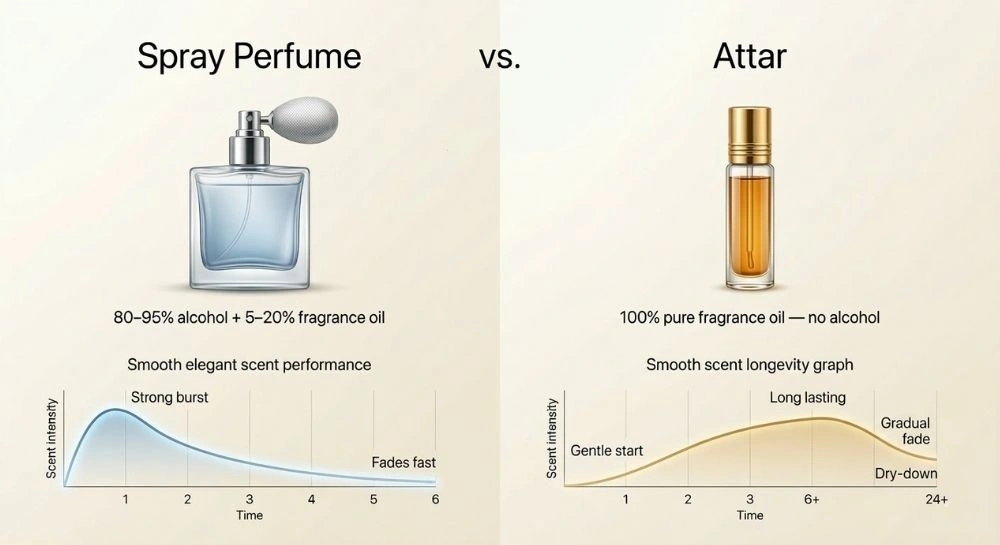
A spray perfume is mostly alcohol. Like 80 to 95% alcohol.
When you spray it, that alcohol evaporates fast and throws the fragrance into the air around you. That’s why you get that strong burst right when you spray.
But it also means the scent fades pretty quickly because the alcohol is gone and there’s not much actual fragrance oil left on your skin.
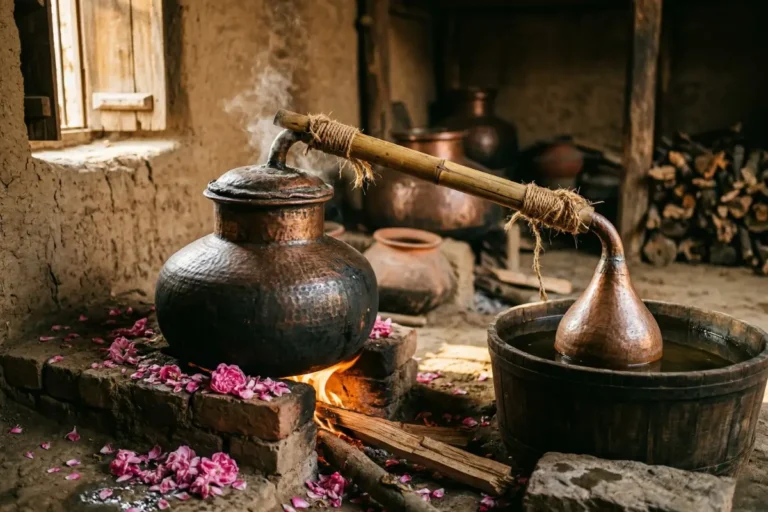
Attar is the opposite. It’s pure fragrance oil. No alcohol. The process behind that oil is fascinating — it takes weeks of copper-still distillation to produce. (I wrote a full guide on how attar is made if you want to see what actually goes into every drop.)
So when you apply it, there’s no big initial burst. It just sits on your skin and slowly releases the scent as your body heat warms it up.
Think of it like this. A spray perfume is like lighting a matchstick. Bright flame, gone fast.
Attar is like a diya. Slow, steady, lasts for hours.
This changes everything about how you use it.
- You can’t spray attar. There’s no nozzle, no mist. You dab it. Which means you need to be more intentional about where you put it and how much you use.
- You need way less of it. One drop of a good attar has more fragrance concentration than five or six sprays of an EDP. So if you apply attar the way you apply perfume, you’re going to walk into a room, and people are going to step back.
- It blends with your skin differently. Because it’s oil based, attar actually mixes with your body’s natural oils. That’s why the same attar can smell slightly different on two different people. Your skin chemistry, your body heat, even how oily or dry your skin is, all of that changes the final scent.
| Spray Perfume | Attar | |
|---|---|---|
| Base | 80-95% alcohol | 100% pure oil |
| How you apply | Spray / spritz | Dab / roll |
| Longevity | 2-4 hours typical | 6-24 hours typical |
| Sillage | Room-filling burst | Intimate, close scent |
| Skin interaction | Sits on top, evaporates fast | Blends with your natural oils |
| Reapplication | Needed every few hours | Once or twice a day |
So yeah, different format, different rules. And once you understand these differences, the rest of this guide is going to make a lot more sense.
If you want to go deeper into how attars, perfumes, and EDPs actually compare, I wrote a detailed guide on attar vs perfume vs EDP that breaks down everything.
2. Before You Apply: Prep Your Skin
Most people skip this part completely. They just open the bottle and start dabbing. And then they wonder why their attar disappeared in two hours.
The thing is, attar is an oil. And how your skin receives that oil makes a huge difference in how long the fragrance sticks around and how it smells on you. A little bit of prep goes a long way.
Start With Clean Skin
This one’s obvious, but people still skip it.
Sweat, dirt, leftover deodorant, all of that creates a layer between the attar and your skin. It can mess with the scent and stop it from absorbing properly.
You don’t need to take a full shower every time. Just make sure your pulse points (wrists, neck) are clean.
Moisturize With Something Unscented
This is honestly the biggest trick for making attar last longer. Here’s why.
When your skin is dry, it’s thirsty for moisture. So when you put attar on dry skin, your skin just drinks it up for hydration. The oil gets absorbed, and there’s barely anything left on the surface to actually release fragrance.
A light layer of unscented lotion or a carrier oil like coconut or jojoba fixes this. It gives the attar something to sit on instead of sinking straight in.
One thing, though. This depends on the season and where you are in India:
- In humid months (monsoon, coastal cities), your skin already has enough natural moisture. You probably don’t need extra moisturizer.
- In dry winters (especially North India, Delhi, Rajasthan), your skin gets really dry. Moisturizing before attar becomes almost mandatory if you want any kind of longevity.
Let Your Skin Dry Fully After a Shower
I know some guides say to apply on damp skin. That works for spray perfumes because the alcohol binds differently.
But with attar, water on your skin just dilutes the oil. Let your skin dry completely first, then moisturize, then apply.
Use Clean Hands
You’re going to touch the applicator stick or roller and then touch your skin. If your fingers have oil, dirt, or food residue on them, that’s going straight into your attar bottle.
Over time, it can actually spoil the attar. Always wash your hands before you open that bottle.
3. Where to Apply Attar: The Pulse Points
This is the part that actually matters the most. You could have the best attar in the world, but if you’re putting it in the wrong spots, you’re wasting it.
The idea is simple. Attar needs heat to release its fragrance. And certain spots on your body are naturally warmer because blood vessels are closer to the skin there.
These are called pulse points. When you apply attar on these spots, your body heat slowly warms the oil and pushes the scent outward throughout the day.
Here are the spots I’d recommend, ranked by how effective they are.

Inner Wrists
The classic spot. Everyone knows this one and for good reason.
Your wrists are warm, they’re exposed, and they move around a lot, which helps spread the scent naturally. This is also the easiest spot to reapply during the day.
But here’s the most important rule. Dab the attar on one wrist, then gently press the other wrist against it. Don’t rub. I’ll say it again. Do not rub your wrists together.
Rubbing creates friction heat that breaks down the fragrance molecules, especially the top notes. It’s the single most common mistake people make, and it kills the scent faster than anything.
Sides of the Neck
Right below your jawline, on both sides.
This area is warm, and the scent rises upward from here, so people around you will notice it naturally. If I’m only picking two spots for the day, it’s wrists and neck. That combo covers you for pretty much any situation.
Behind the Ears
More subtle than the neck. The scent stays closer to you here, so it’s better for situations where you want something intimate rather than projecting across the room.
If you’re going out for dinner or meeting someone, this is a good spot to add.
Inner Elbows
People overlook this one a lot.
Your inner elbows generate a good amount of heat, especially when you’re moving your arms. And because it’s a slightly hidden spot, the fragrance comes and goes in gentle waves as you move.
Really nice for office or daily wear, where you want something consistent but not loud.
Behind the Knees
This one sounds odd, but it actually works.
Heat rises. So when you apply attar behind your knees, the scent slowly moves upward and creates this full-body effect.
It’s not going to be the spot you use every day, but for occasions where you want to smell great from head to toe, add this to the mix.
Chest and Collarbone
This one’s more for yourself than for others.
The scent stays close to your body here, so you’ll catch whiffs of it throughout the day.
I like this spot when I’m wearing an attar that I personally enjoy smelling, not necessarily to impress anyone, just for my own mood.
Hair and Beard
Attar clings to hair really well. Way better than skin actually, because hair fibers hold onto oil.
A tiny amount on your beard tips or the ends of your hair creates a scent trail that lasts. Just keep it light, though. Too much and your hair can start feeling oily.
How Many Spots Should You Actually Use?
This is where people go overboard. You don’t need to hit every pulse point every time. That’s how you end up being the person everyone smells before they see.
- Daily wear or office: Pick 2 spots. Wrists and neck is the safest combo.
- Evening out or a date: 2 to 3 spots. Maybe add behind the ears.
- Wedding or special occasion: 3 to 4 spots. You can be a little more generous here.
The general rule is simple. You should be a pleasant surprise at close range, not an announcement from across the room.
4. How to Apply Attar: The Three Methods
So you know where to apply it. Now let’s talk about how. Because depending on what kind of bottle your attar comes in, the technique changes a bit.
Most attars come in one of three formats. A stick applicator, a roller ball, or an open mouth bottle with a dropper. Each one needs a slightly different approach, and getting this right helps you avoid wasting product or applying too much.
Method 1: The Stick Applicator
This is the most traditional format.
If you’ve ever bought attar from a local shop or ordered a Kannauj-style bottle, you’ve seen these. It’s a small glass or wooden stick attached to the cap that dips into the oil.
Here’s how to use it properly.
Pull the stick out and hold it over the bottle for two to three seconds. Let the excess oil drip back in. You don’t want a loaded stick dripping everywhere. What’s left clinging to the stick is usually the right amount for one pulse point.
Now touch the stick gently to your wrist or neck. That’s one application.
If you want it on both wrists, dab one wrist and then lightly press the two wrists together. Don’t go back into the bottle for a second dip unless you’re applying to a completely different spot.
One hygiene tip. Always put the stick right back into the bottle after use. Don’t set it down on a table or counter. Dust and bacteria get on it and then go straight into your attar next time you close the cap.
Method 2: The Roller Ball
This is the most common format you’ll find these days, especially with modern attar brands and concentrated perfume oils. It’s also the easiest to use.
One smooth swipe across the pulse point. That’s it. Don’t roll it back and forth five times like you’re painting a wall. One pass gives you enough oil for a good application.
Rollers are great for reapplication, too. They’re clean, quick, and easy to carry in your pocket. If you’re someone who likes to refresh your scent after lunch or before an evening plan, a roller bottle is your best friend.
Method 3: Open Mouth Bottle or Dropper
Some high-end attars and bulk bottles come without a stick or roller. Just an open mouth or a glass dropper. These need the most care because it’s really easy to use too much.
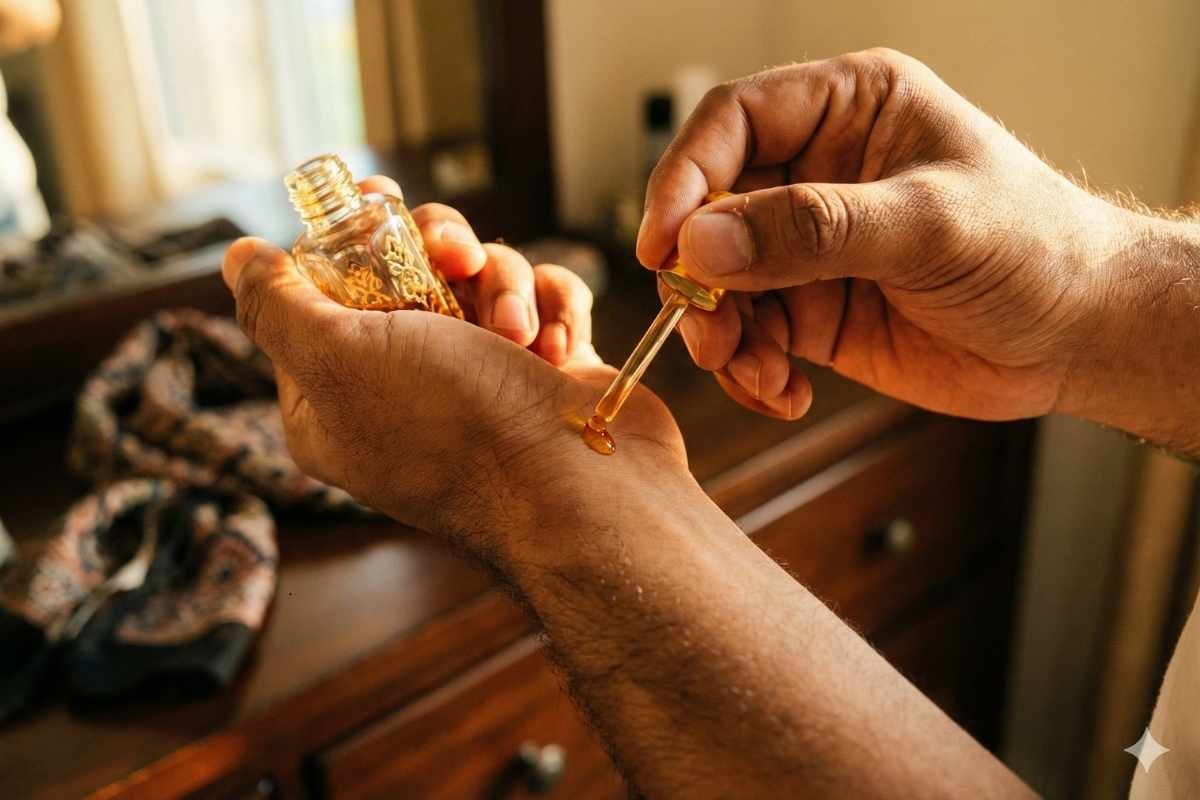
With a dropper, squeeze out one small drop onto your clean fingertip. Then dab that fingertip onto your pulse point.
One drop per spot is the rule here.
If you’re using an open-mouth bottle, tip it very slightly against your fingertip. You want the tiniest amount. Think about the size of a grain of rice. That’s enough.
This format wastes the most attar if you’re not careful. So take your time with it.
The Indirect Method: Applying on Clothes
This one gets its own detailed section later in this guide, but here’s the basic technique.
Put a small drop of attar on your palm. Rub both palms together lightly, just enough to spread the oil thin. Then sweep your palms gently over your clothes. The collar area, the chest of your kurta or shirt, the cuffs of your sleeves.
This way the oil never touches the fabric directly in a concentrated spot, which is how stains happen. You’re spreading a thin, even layer instead.
I go into a lot more detail on this, including which fabrics are safe and which attars can stain in the clothes section below. So keep reading if this is something you want to do regularly.
5. How Much Attar Should You Apply?
This is the question nobody answers properly. Every guide out there says “a drop or two” and leaves it at that. But how much is a drop? And does every attar need the same amount?
Not really. Let me break this down.
The General Rule
One drop per pulse point. Seriously, that’s it.
Attar is extremely concentrated compared to spray perfumes. If you can smell your own attar strongly five minutes after applying, you’ve probably used too much.
And here’s something most people don’t realize.
Your nose adjusts to your own scent very quickly. It’s called olfactory fatigue. After about ten to fifteen minutes, you’ll stop noticing your attar almost completely. But everyone around you can still smell it just fine. So don’t keep adding more just because you think it’s faded. It probably hasn’t.
Adjust by Attar Type
Not all attars have the same strength. The amount you use should depend on what you’re wearing.
- Light florals (rose, jasmine, kewra, mogra): These are softer in projection. You can afford to be slightly more generous. Two dabs on each pulse point instead of one is fine.
- Sandalwood based attars: Moderate strength. One dab is usually enough. Sandalwood has natural staying power, so it doesn’t need much help.
- Oud and heavy resinous attars: Use the bare minimum. A tiny dab goes a really long way with these. Oud can project aggressively, especially in warm weather. If you overdo it, it can be overwhelming for people around you.
- Musk attars: These are tricky. On some skin types, musk goes “skin scent” really fast, meaning it stays very close to your body and doesn’t project much. You might need a touch more than you think, but start small and build up.
Adjust by Occasion
How much you apply should also change depending on where you’re going.
- Office or daily commute: Light application. 1 to 2 pulse points. You’re in a closed space with people, so less is more.
- Evening out or a date: Standard application. 2 to 3 pulse points. You want to be noticed but not overpowering.
- Wedding or special event: You can go a bit heavier. 3 to 4 pulse points, slightly more generous dabs. Bigger spaces, more people, more ambient noise of scents everywhere.
- Religious or spiritual use: This varies by tradition. But typically wrists, neck, and beard are the main spots.
The Best Way to Check
Here’s what I do.
Apply your attar, wait about ten minutes, then ask someone near you if they can smell it and how strong it is.
Your own nose is the worst judge of your own fragrance. A quick check from a friend or family member will tell you instantly if you’ve got the balance right.
6. Applying Attar in Indian Weather
If you live in India, this is probably the most important part of this whole guide.
Most attar application advice assumes a mild, moderate climate. But that’s not how things work here.
In May, your car dashboard can melt a chocolate bar in ten minutes. Mumbai in August feels like breathing inside a steam room.
Indian weather changes how attar behaves on your skin in a big way, and your application needs to change with it.
Summer (April to September)
Your body temperature is already high. The air is hot. Your skin is warm even before you step outside. All of this means your attar is going to project harder and faster than it would in cooler weather.
So the most important rule for Indian summers is simple. Use 30 to 50% less than you normally would.
If you usually do a full drop on each wrist, bring it down to a light dab. One pulse point might be enough for a whole day in peak summer.
A few more things to keep in mind:
- Stick to lighter attars. Rose, jasmine, mogra, kewra, vetiver (khus). These are made for heat. Heavy oud or thick sandalwood blends can feel suffocating when it’s 40 degrees outside.
- Sweat helps diffusion, but too much washes it away. Apply after your morning routine when you’re clean and dry. Not right before heading out into the sun.
- AC to outdoor transitions are tricky. If you go back and forth between air conditioned spaces and outdoor heat throughout the day, your attar will behave differently each time. You might need a light reapply in the afternoon.
And if you’re in a coastal city like Mumbai, Chennai, or Kolkata, the humidity makes everything project more. Dial your application down even further.
What feels like barely anything on your skin can still be clearly noticeable to people around you.
Winter (November to February, Especially North India)
Winter is the opposite situation. Cold skin means less body heat, which means less projection. Your attar is going to stay closer to your body and won’t travel as far.
This is when you can be more generous with application. 3 to 4 pulse points, slightly bigger dabs. You won’t overwhelm anyone because the cold air keeps things in check.
This is also the best season for your heavier attars. Oud, amber, shamama, musk, rich sandalwood blends.
These come alive in cold weather. They feel warm and cozy on the skin in a way that just doesn’t work in summer.
One tip that works really well in winter. Apply right after a hot shower. Your pores are still open, your skin is warm, and the attar absorbs beautifully. It gets a head start before you step out into the cold, and that initial warmth helps it settle properly.
Also, attars actually last longer in winter because the cold slows down evaporation. So even though the projection is less, the longevity can be better.
Don’t mistake low projection for the attar fading. It’s still there, just staying closer to you.
Monsoon (July to September)
The most underrated season for wearing attar.
And I genuinely believe mitti attar was made specifically for this time of the year. That petrichor scent on a rainy evening is something else.
Humidity is high during monsoon, so the same rules as summer apply. Keep your application light. But the air already carries a lot of moisture, and that moisture can actually help your attar bloom and spread in a really natural way.
Light florals, mitti, and vetiver work beautifully during monsoon. Save the heavy stuff for winter.
AC vs Non-AC Environments
This one doesn’t get talked about enough, and it’s relevant to almost everyone in India.
Air conditioning dries your skin out. If you’re sitting in an AC office all day, your skin is losing moisture constantly. And dry skin doesn’t hold attar well.
So if you know you’ll be in AC for hours, moisturizing before application becomes even more important. That barrier layer is doing real work here.
Non-AC environments like autos, local trains, buses, outdoor markets, your body heat is doing all the heavy lifting. The attar will project more than you expect. Use less and let your natural warmth do the work.
7. Applying Attar on Clothes
After pulse points, this is the second most common question people have.
Can I put attar on my clothes? Yes. But you need to know what you’re doing, because one wrong move and you’ve got a permanent stain on your favorite white kurta.
Applying attar on clothes actually makes a lot of sense. Fabric holds scent much longer than skin, especially natural fibers like cotton and linen.
Your grandfather probably applied attar to his kurta collar every morning. It’s a very traditional Indian way of wearing fragrance.
But modern attars come in all kinds of concentrations and colors, so you can’t just apply blindly.
Why Apply on Clothes?
If you have dry skin that eats up attar quickly, clothes give the fragrance something to cling to for much longer.
The scent from fabric also diffuses differently. It’s softer, more gradual, like a gentle background presence rather than a direct hit from your skin.
Some people prefer this, especially for daily wear.
The Golden Rule: Never Apply Directly
Don’t take the applicator stick or roller and touch it straight to your fabric. That’s a concentrated drop of oil hitting one spot, and depending on the attar, it can leave a visible mark.
Instead, use the indirect method:
- Put a small drop of attar on your palm
- Rub both palms together lightly to spread the oil thin
- Sweep your palms gently over the fabric
This distributes the attar evenly without any concentrated spots. Much safer.
Which Attars Stain and Which Don’t?
This is important, and almost nobody talks about it clearly.
- Dark colored attars will stain light fabrics. Oud attars, saffron based attars, deep amber attars. These are usually dark brown or golden in color. Keep them away from white, cream, or light colored clothes.
- Light colored attars are generally safer. Rose, jasmine, kewra, most floral attars are pale or almost clear. These rarely leave visible marks on fabric.
- When in doubt, test first. Dab a tiny amount on an inside seam or a hidden area. Check after an hour. If there’s no mark, you’re good.
Which Fabrics Work Best?
- Cotton and linen: Best choice. They absorb attar well and hold the scent for a long time. Darker colors are safest.
- Wool: Holds scent really well, great for winter shawls and jackets.
- Silk: Be very careful. Silk absorbs oil permanently and stains easily. I’d avoid applying attar on silk unless you’ve tested it thoroughly.
- Polyester and synthetics: These don’t hold scent well at all. The attar kind of sits on the surface and fades quickly. Not worth it.
Best Spots on Your Clothes
Don’t just apply everywhere. Focus on areas where there’s some body heat and movement to help the scent diffuse:
- Inner collar area
- Cuffs or sleeve edges
- Dupatta or scarf
- Inside of a jacket or blazer
The Cotton Ball Trick
This is an old trick from the Kannauj attar community, and it works beautifully.
Take a small piece of cotton, dip it lightly in your attar, and tuck it into your shirt’s front pocket. Or slip it inside your collar.
The cotton slowly releases the fragrance throughout the day without any direct contact with your fabric. No stain risk. No waste. Just a gentle, consistent scent.
I use this method a lot when I’m wearing a light colored shirt and don’t want to risk any marks. It’s simple, and it just works.
Removing Attar Stains
Accidents happen. If you do get an oil mark on your clothes:
- Cotton fabrics: Dab the spot with a little rubbing alcohol or dishwashing liquid. Let it sit for ten minutes, then wash normally.
- Silk or delicate fabrics: Take it to a dry cleaner. Don’t try to fix it yourself, you’ll probably make it worse.
- Old stains: These are tougher. Baking soda paste left on the spot overnight before washing can help, but no guarantees with set in stains.
8. How to Make Your Attar Last Longer
If you’ve followed everything in this guide so far, your attar is already lasting way longer than it used to. But let me put it all together in one place, plus a few extra tricks that really help.
Moisturize Before Applying
I’ve said this already, but it’s worth repeating because it’s the single biggest factor.
Moisturized skin can hold attar for two to three extra hours compared to dry skin. Use an unscented lotion or a light carrier oil like jojoba or coconut oil on your pulse points before you apply.
Apply on Pulse Points
Your body heat is what releases the scent. Pulse points are the warmest areas on your body, so the attar gets a slow and steady push throughout the day.
Random spots like your forearm or the back of your hand don’t generate enough heat to keep things going.
Don’t Rub
I keep coming back to this because it really matters.
Rubbing doesn’t spread the attar better. It just creates friction that breaks apart the fragrance molecules. The top notes vanish almost instantly, and you’re left with a flatter version of what the attar is supposed to smell like.
Dab and press. That’s all you need.
Layer With a Base
This is a trick that a lot of people don’t know about.
Before applying your attar, put a thin layer of petroleum jelly (Vaseline) or unscented coconut oil on the pulse point. Then apply the attar on top of that.
What this does is create a barrier between the attar and your skin. Instead of your skin absorbing the oil, the attar sits on the surface and releases fragrance for much longer.
It’s a small step, but the difference is noticeable.
Apply on Both Skin and Clothes
Don’t pick one or the other. Do both.
Attar on your skin gives you that natural, evolving scent that changes with your body chemistry. Attar on your clothes gives you longevity because fabric holds oil much longer.
Together, you get the best of both.
Reapply Smart
Attar lasts longer than spray perfumes, but it’s not immortal. If you applied in the morning and it’s now late afternoon, a quick dab on the wrists is usually all you need.
Carry a small roller or your attar bottle with you. One swipe takes two seconds and gets you through the rest of the day.
Store Your Attar Properly
A poorly stored attar loses its potency over time. And degraded attar simply doesn’t perform the way it should.
I’ll cover storage in detail in the next section, but the short version is keep it in a cool, dark place, seal the cap tight, and keep it away from heat and sunlight.
Why Your Attar Might Not Be Lasting
If you’ve tried everything and your attar still disappears in a couple of hours, here are the most common reasons:
- Dry skin. Your skin is absorbing the oil for hydration. Fix this with moisturizer.
- Olfactory fatigue. You can’t smell it, but others can. Ask someone around you before assuming it’s gone.
- Low quality attar. Synthetic or heavily diluted attars don’t have the complex molecular structure that gives natural attars their staying power. They just fade faster. If you bought a 10ml attar for 50 rupees, this might be the issue.
- Over rubbing. You already know why this is bad.
- Extreme heat burning it off. In peak Indian summer, even a good attar can fade faster. Use less but reapply once during the day.
9. Layering Attars: Creating Your Signature Scent
Once you’re comfortable applying a single attar, this is where things get really fun.
Layering means wearing two or sometimes three different attars at the same time to create a scent that’s completely yours.
Something nobody else is wearing because nobody else has that exact combination.
And the cool thing about attars is that they’re perfect for layering. Because they’re oil based, they blend into each other smoothly on your skin. No harsh alcohol clashing. Just two scents slowly merging together with your body heat.
How Layering Actually Works
The idea is simple. You apply one attar on one pulse point and a different attar on another pulse point. That’s it.
You’re not mixing them in a bottle or applying one on top of the other on the same spot.
Putting two attars on the same spot usually just creates a muddy mess where neither scent comes through properly.
When they’re on separate pulse points, each attar develops on its own, but the overall effect is a blended scent that people around you experience as one fragrance.
Your sandalwood on the wrists and rose on the neck become a sandalwood-rose experience for anyone near you.
The Basic Framework
Start with the heavier attar first. Apply your darker, deeper scent to one set of pulse points. This becomes your base, the foundation of your scent.
Then apply the lighter, brighter attar to a different set of points. This becomes the top layer, the first thing people notice.
Think of it like getting dressed. The heavier attar is your shirt. The lighter attar is the jacket over it.
Combinations That Work Really Well
I’ve tried a lot of combinations over time. Here are some that I keep coming back to:
- Sandalwood on wrists + Rose on neck. This is the classic Indian combination. Warm, elegant, works in almost any situation. If you’re new to layering, start here.
- Oud on inner elbows + Jasmine on wrists. Rich and deep from the oud, but the jasmine lifts it and keeps it from feeling too heavy. Great for evenings.
- Vetiver on wrists + Mitti on neck. This is my monsoon combo. Earthy, grounding, and it just fits perfectly with rainy weather.
- Musk on neck + Kewra on wrists. Light, fresh, easy to wear. This one works really well in summer when you want something present but not heavy.
These are starting points. The whole fun of layering is experimenting and finding what works on your skin.
What smells amazing on me might be completely different on you because our skin chemistry is different.
Layering Attar With Spray Perfumes
Yes, you can absolutely do this. And it’s actually a great trick.
Apply your attar first. Let it settle on your skin for about five minutes. Then spray your EDP or EDT on top.
The attar acts as a base layer that gives your spray perfume more depth and way more longevity. The spray gives you that initial burst of projection that attars don’t really have on their own.
The key is to match the families. Woody attar under a woody perfume. Floral attar under a floral perfume. Don’t put a heavy oud attar under a fresh aquatic spray. That’s going to fight, not blend.
One Important Rule
Don’t layer more than two attars unless you really know what you’re doing. Three can work if the scents are in the same family. But most of the time, two is the sweet spot.
More than that, and things get messy and confusing. Your nose won’t know what’s happening, and neither will anyone else’s.
10. Common Mistakes to Avoid
I’ve made most of these mistakes myself at some point. So if you’re doing any of these, don’t feel bad. Just fix them, and you’ll notice the difference immediately.
Rubbing Your Wrists Together
I’ve talked about this multiple times in this guide already, and there’s a reason for that.
It’s the most common mistake, and it does the most damage.
Rubbing creates friction heat that destroys the delicate top notes of your attar. What you’re left with is a flatter, duller version of the scent. Dab and press. Never rub.
Applying Too Much
More attar doesn’t mean more fragrance. It means more overwhelming fragrance.
Attar is concentrated. A little goes a long way. If the person sitting next to you on the metro is turning their head away, you’ve overdone it.
You want to be a pleasant discovery when someone comes close, not a wall of scent they hit from three feet away.
Applying on Dry Skin
Dry skin absorbs the oil for moisture, leaving almost nothing on the surface to project fragrance.
This is the number one reason people complain about attar not lasting. A layer of unscented moisturizer before application fixes this completely.
Using the Same Amount Year Round
This is a mistake I see a lot of people make without even realizing it.
Your summer application and your winter application should not be the same. Indian summer heat amplifies everything.
What felt like a normal amount in January can become way too much in May. Adjust with the seasons.
Mixing Attar With Strong Deodorants or Body Sprays
If you’re wearing attar, use an unscented deodorant. A strong deo or body spray has its own fragrance that’s going to clash with your attar.
Two strong scents fighting each other on your body doesn’t create a good experience for anyone. Let the attar do its job on its own.
Putting Dark Attars on Light Clothes
I covered this in the clothes section, but it’s worth repeating here.
Dark oud, saffron, and amber attars will stain white and cream fabrics. Always use the indirect method and test on a hidden spot first. Or just stick to wearing these attars on darker clothes.
Storing Attar in the Bathroom
Your bathroom is the worst place for attar. The humidity from showers, the temperature changes, all of it breaks down the oil over time.
Keep your bottles in a drawer or cupboard in your bedroom. Cool, dark, and dry.
Applying on Sweaty Skin
Sweat and attar don’t mix well.
The sweat creates a barrier, dilutes the oil, and can change the scent in ways you don’t want. Always apply on clean, dry skin. If you’ve been sweating, wipe down your pulse points first.
Thinking Your Attar Has Stopped Working
This trips up so many people.
You apply your attar in the morning. By noon, you can’t smell it at all. So you assume it’s gone and apply more.
But it’s not gone. Your nose has just adapted to it.
This is olfactory fatigue, and it happens with every fragrance. Before you reapply, ask someone nearby if they can still smell it. Nine times out of ten, they can.
Comparing Attar Sillage to Spray Perfume
Attars are not designed to fill an entire room the way a strong EDP does. They create a more intimate scent bubble around you.
Someone needs to be within a couple of feet to really notice it. That’s not a flaw. That’s how attar is supposed to work.
If you’re judging your attar by spray perfume standards, you’ll always be disappointed.
11. How to Store Your Attar
Good application won’t save a badly stored attar.
If your attar has been sitting on a windowsill or in a hot bathroom for months, the oil has already started degrading.
And degraded attar doesn’t smell right, doesn’t last as long, and basically loses everything that made it worth buying.
The good news is that proper storage is really simple.
A well-stored attar can last for years. Some people even say attars get better with age, like wine. The molecules settle, the notes deepen, and the scent becomes richer over time.
But that only happens if you treat the bottle right.
Keep It Away From Sunlight
UV light breaks down the compounds in attar.
This is why most good attar bottles are made from dark or opaque glass. But even with dark glass, don’t leave your bottle on a shelf that gets direct sunlight.
A dresser drawer or the inside of a cupboard is perfect.
Store in a Cool, Dry Place
Heat speeds up the chemical breakdown of natural oils. And humidity introduces moisture that can mess with the attar’s composition over time.
Your bedroom drawer or wardrobe works great. Your bathroom does not.
If you live somewhere that gets extremely hot in summer and you don’t have AC, keep your attars in the coolest part of your house.
A closed cupboard on the ground floor is usually cooler than an upper shelf.
Seal the Cap Tight Every Single Time
Oxygen causes oxidation.
Every time you leave the cap open or loose, air gets in and slowly changes the scent. Make it a habit. Open, apply, close. Don’t leave the bottle sitting open while you get dressed or have a conversation.
Five seconds of being careless adds up over months.
Don’t Transfer to Plastic Containers
Plastic reacts with natural oils over time.
It can alter the scent and even break down the plastic itself. Always keep your attar in its original glass bottle.
If you want to carry a small amount for travel, use a mini glass roller bottle. You can find these easily online for very cheap.
What About Keeping Attar in the Fridge?
This comes up a lot. And the answer is it depends.
For bottles you’re not using regularly and want to store long term, the fridge can work. The cool temperature slows down any degradation.
But for your daily-use bottle, I’d skip the fridge.
Taking it out every morning and putting it back creates temperature fluctuations. The bottle goes from cold to room temperature and back every day. That causes condensation inside the bottle, and water droplets mixing with your attar is not good.
So keep your daily bottles in a drawer at room temperature. Put the ones you’re saving for later in the fridge. That’s the best approach.
Quick Reference: Your Daily Attar Routine
If you’ve read the whole guide and just want a simple routine to follow every day, here it is.
Morning routine in under two minutes:
- Clean your pulse points (or apply after your shower)
- Apply a thin layer of unscented moisturizer on wrists and neck
- Wait thirty seconds for it to absorb
- One dab of attar on each wrist. Gently press wrists together. Don’t rub.
- One dab on the side of your neck
- Close the bottle. Done.
Seasonal adjustments:
- Summer: Less is more. Light florals and vetiver. 1 to 2 pulse points. Light dabs.
- Winter: Be generous. Heavier attars like oud, musk, shamama. 3 to 4 pulse points.
- Monsoon: Keep it light. Mitti and vetiver are perfect for this season.
On clothes: Always use the indirect method. Palm to palm, then sweep over fabric. Test for staining first.
Reapply: A quick dab on the wrists after lunch if needed. That’s usually enough to carry you through the evening.
FAQs
Can I apply attar directly on my skin?
Yes. Pure natural attars are safe for direct skin application. That’s actually the best way to wear them because your body heat helps release the fragrance. If you have very sensitive skin or you’re trying a new attar for the first time, do a small patch test on your inner elbow. Wait an hour and see if there’s any irritation. Most natural attars are perfectly fine, but synthetic ones can sometimes cause reactions.
How many drops of attar should I use?
One drop per pulse point is a good starting point. For lighter florals you can do two light dabs. For strong attars like oud, even half a drop is enough. Start small and build up. You can always add more, but you can’t take it off once it’s on your skin.
Does attar stain clothes?
It can. Dark colored attars like oud, saffron, and amber can leave visible marks on light fabrics. Light colored attars like rose and jasmine are usually safe. Always use the indirect application method and test on a hidden spot first.
How long does attar last on skin?
A good quality natural attar can last anywhere from 6 to 12 hours on moisturized skin. Some heavier attars like oud and sandalwood can still be faintly noticeable the next morning. Longevity depends on the attar’s quality, your skin type, the weather, and how you applied it.
Can I mix attar with perfume?
Absolutely. Apply the attar first, let it settle for five minutes, then spray your perfume on top. The attar acts as a long lasting base layer and the spray gives you the initial projection. Just make sure both are from the same scent family. Woody with woody, floral with floral.
Is attar safe for sensitive skin?
Natural attars are generally gentler than alcohol based perfumes because they don’t contain alcohol or synthetic chemicals. But “natural” doesn’t automatically mean it’ll work for everyone. Some people can be sensitive to specific botanicals. A patch test before first use is always a good idea.
Where is the best place to apply attar?
Inner wrists and the sides of your neck. That’s the best two point combo for daily wear. These areas are warm, exposed, and help the scent project naturally. If you want more coverage, add behind the ears or inner elbows.
Why does my attar smell different on me than in the bottle?
Because attar is oil based, it interacts with your skin’s natural oils, your body heat, and your unique chemistry. Two people wearing the same attar will smell slightly different. This is actually one of the best things about attar. The scent becomes personal to you. Give it fifteen to twenty minutes after applying to judge the real scent. The opening can be different from how it settles.
How do I apply attar without wasting it?
Use the right technique for your bottle type. With a stick applicator, let the excess drip back before dabbing. With a roller, one smooth swipe is enough. With a dropper, aim for one small drop on your fingertip. And always close the bottle immediately after use to prevent evaporation.
Can I apply attar on my hair?
Yes, and hair actually holds attar longer than skin because the fibers grip the oil. A tiny amount on the ends of your hair or beard tips creates a nice, subtle scent trail. Just don’t overdo it because too much can make your hair feel greasy. A touch is all you need.