How Attar is Made — The Complete Guide to India’s Ancient Perfume Craft
The first real attar I ever wore was a rose attar from a small shop in Jaipur.
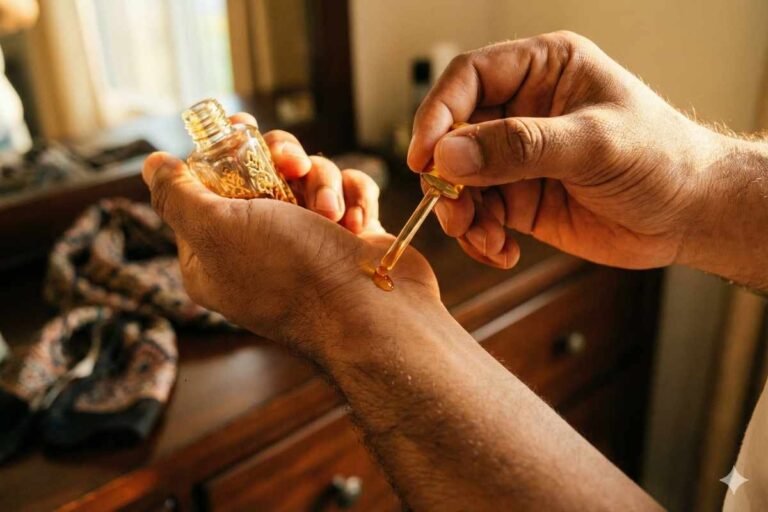
The guy behind the counter dabbed a tiny drop on my wrist, and I expected it to smell like rose perfume. It didn’t. It smelled like a living flower that was slowly opening on my skin.
Three hours later, it was still there. Six hours later, still there but different now. Warmer. Deeper. More like wood and skin than rose.
By evening, I couldn’t stop thinking about what was actually inside that tiny bottle.
That curiosity sent me down a rabbit hole I haven’t come out of yet.
Turns out, the attar on my wrist that day wasn’t “made” the way most fragrances are made. Nobody mixed chemicals in a lab. Nobody blended pre-made oils in a factory.
What happened was far stranger and far older.
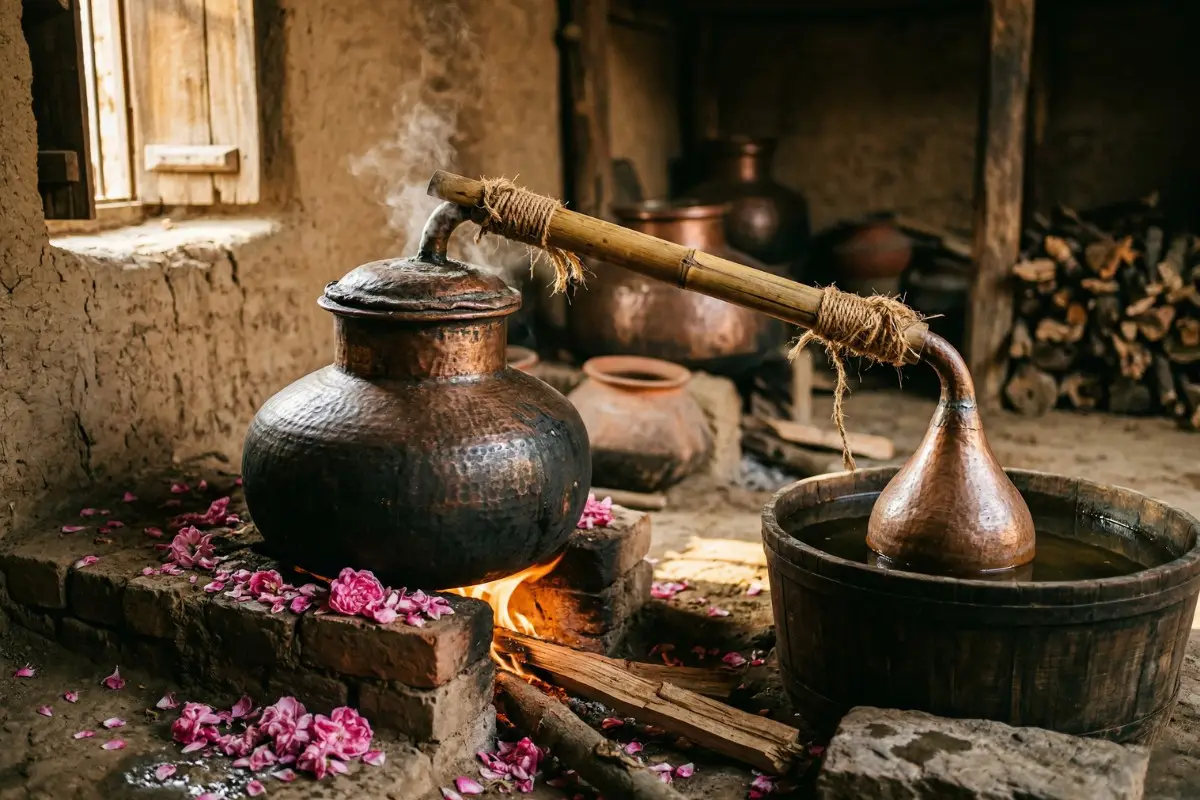
Somewhere in Kannauj, a small city in Uttar Pradesh that has been India’s perfume capital for over a thousand years, someone loaded fresh rose petals into a copper still before sunrise.
They sealed it with clay. They lit a wood fire underneath and kept it burning, gently, for eight hours straight. The fragrant steam traveled through a bamboo pipe into a second copper vessel filled with sandalwood oil.
And they did this every single day, with fresh flowers, for fifteen to twenty days in a row.
The sandalwood oil slowly absorbed the rose until it stopped smelling like sandalwood entirely and became rose.
That is how attar is made. Not assembled. Not formulated. Grown into existence over weeks inside a copper still, using a process that hasn’t fundamentally changed in centuries.
This guide covers the entire journey from flower field to finished bottle:
- The raw ingredients and where they come from across India
- The ancient deg-bhapka distillation process in proper detail, not the two-paragraph version you find everywhere else
- The science behind why it works, explained without a chemistry degree
- The different types of attar, from single-flower to complex blends like shamama
- The history of Kannauj and why it matters
- The uncomfortable reality that this tradition is fighting for survival against sandalwood scarcity, synthetic competition, and a generation that would rather work in cities than tend copper stills
I haven’t visited Kannauj yet. That trip is on my list, and it will happen. But I’ve spent weeks pulling from academic research, artisan accounts, journalist features, and industry reports to put this together.
And I’ve worn and tested dozens of attars across Rajasthan summers. I know how these fragrances actually behave on skin in 40-degree heat, not just how they read on paper.
The goal was simple: make this the most complete, most honest guide to how attar is made that exists anywhere on the internet.
New to attars entirely? Start with our What is Attar? The Complete Beginner’s Guide first. If you already know the basics and want to understand the craft, keep reading.
Table of Contents
- 1. What Goes Into an Attar — The Raw Ingredients
- 2. Why Sandalwood is the Soul of Every True Attar
- 3. The Deg-Bhapka Method — How Attar is Actually Distilled, Step by Step
- 4. The Master Distiller — Why Human Senses Replace Modern Instruments
- 5. The Simple Science Behind Attar Distillation
- 6. Types of Attar by How They’re Made
- 7. How Traditional Attar-Making Compares with Modern Extraction Methods
- 8. How to Tell Real Attar from Fake
- 9. Kannauj — India’s Perfume Capital for Over 1,000 Years
- 10. Why This Ancient Craft is Fighting to Survive
- What a Single Drop Actually Represents
- FAQs
1. What Goes Into an Attar — The Raw Ingredients
Most people assume attar is made from flowers. That’s partly right. But the full ingredient list for Indian attars goes way beyond petals.
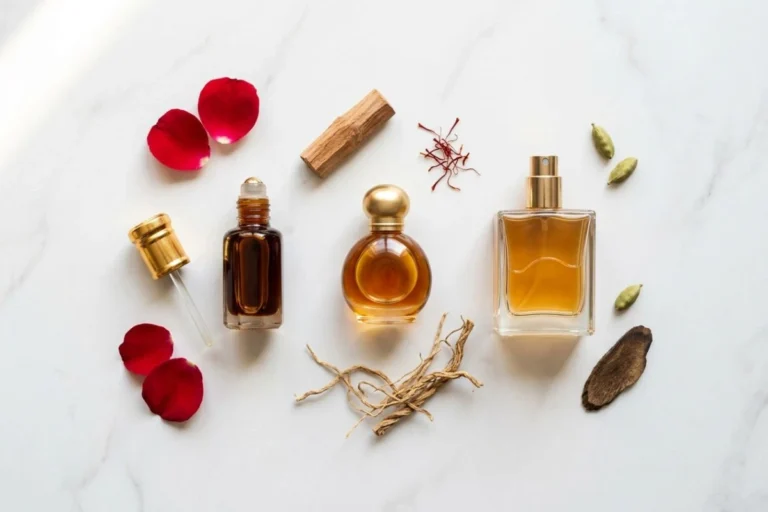
We’re talking roots, bark, resins, spices, baked earth, and even charred seashells. The botanical palette is massive. And where each ingredient comes from, when it’s harvested, and how fast it reaches the still matters more than most people realize.
Let’s break it down.
1.1 The flowers
Rosa damascena (Damask rose) is the star of the show.
These pink roses grow in the alluvial plains around Kannauj along the Ganges, and they’re considered some of the most fragrant in the world.
Rose attar season peaks between February and April.
Other key flowers:
- Motia (Jasminum sambac, Arabian jasmine) — the “King of Flowers.” Intensely sweet, intoxicating. Night-blooming, picked before dawn. Most of India’s sambac comes from Madurai, Tamil Nadu.
- Chameli (Jasminum grandiflorum) — lighter, more elegant than motia. Sourced around Coimbatore.
- Kewra (Pandanus odoratissimus, screwpine) — sweet, green, slightly aquatic. Here’s a number that surprised me: 95% of India’s kewra comes from a single district, Ganjam in Odisha.
- Juhi, kadam, champaca, maulshri, tuberose, lotus, raat rani (night queen) — each with its own character, season, and regional source.
1.2 Beyond flowers
This is where Indian attar gets interesting compared to perfumery anywhere else in the world.
- Vetiver/khus (roots, not flowers) is distilled during the scorching summer months. Earthy, cooling, grounding. Grows locally around Kannauj.
- Oud/agarwood comes from infected Aquilaria trees in Assam. One of the most expensive raw materials in all of perfumery.
- Saffron from Kashmir shows up in complex winter blends like shamama and hina.
- Mitti is baked clay from the Ganga’s banks. Yes, actual earth. It gets distilled into sandalwood oil to capture the smell of first rain on dry soil. It deserves its own section later in this guide, and it’s getting one.
- And for compound attars like shamama, you’re looking at 40 to 60+ ingredients, including herbs, spices, barks, resins, Himalayan lichen, and even charred materials called “choyas.” More on that later, too.
Here’s a stat that puts India’s raw material advantage in perspective: India grows 31 of the 300 naturally fragrant raw materials used in global perfumery.
That’s an extraordinary concentration of botanical wealth in one country.
1.3 Why harvest timing is everything
This part matters more than people think, and it directly affects the attar you end up wearing.
Flowers are plucked before sunrise. Not as a tradition for tradition’s sake. There’s a real reason.
Volatile aromatic compounds, the molecules that give flowers their scent, are at peak concentration in the early morning hours before the sun heats them and causes evaporation.
Rose farmers arrive at their fields along the Ganges before first light, filling jute sacks with blossoms when the fragrance is strongest. Jasmine, which blooms at night, is harvested the same way, in the predawn hours.
And here’s the critical part: aromatic molecules start dissipating the moment a flower is plucked. Every hour between harvest and still is lost fragrance.
This is exactly why traditional distilleries in Kannauj are located close to the flower fields. Petals need to reach the copper still the same day they’re picked. Sometimes within hours.
Think about that for a second. You can’t ship these flowers across the country. You can’t stockpile them in a warehouse. The raw material is alive and degrading in real time.
This proximity-to-source requirement is one of the biggest reasons the craft resists industrialization. You can’t centralize it. You can’t scale it the way you’d scale a factory. The flowers won’t wait.
And honestly, as someone who wears attars regularly, this is something you can actually sense in the final product.
An attar made from flowers that reached the still fresh has a quality I can only describe as “alive.”
There’s a brightness, a complexity, a sense of something unfolding on your skin. Compared to a flat, one-dimensional attar that smells like it was made from old or degraded material, the difference is noticeable.
Attar Ingredient Sourcing Map
| Botanical | Source Region | Peak Season |
|---|---|---|
| Rosa damascena (Damask rose) | Kannauj belt, Aligarh, Hathras — UP | Feb–April |
| Motia (Jasmine sambac) | Madurai, Tamil Nadu | Year-round, peaks summer |
| Chameli (J. grandiflorum) | Coimbatore, Tamil Nadu | Summer–monsoon |
| Kewra (Screwpine) | Ganjam, Odisha (95% of India’s supply) | Monsoon season |
| Vetiver/Khus (roots) | Kannauj region, UP | Distilled in peak summer |
| Saffron | Kashmir | October–November harvest |
| Oud/Agarwood | Assam (Aquilaria trees) | Year-round |
| Mitti (baked earth) | Ganga riverbanks, Kannauj | Best from dry, sun-baked clay |
| Sandalwood (base oil) | Historically Karnataka/Kerala — now severely depleted | Trees need 20–50 years to mature |
Related: If you’re wondering what makes attar fundamentally different from alcohol-based perfumes and EDPs, our Attar vs Perfume vs EDP — What’s Actually Different guide covers that in detail.
2. Why Sandalwood is the Soul of Every True Attar
This section could have been a footnote inside the ingredients list. But sandalwood isn’t just another ingredient in attar. It’s the thing that makes attar, attar.
Remove sandalwood from the equation, and you don’t have a slightly different attar. You have a completely different product.
Here’s why.
2.1 What sandalwood actually does in the process
In Western perfumery, you extract essential oils separately and then blend them together with alcohol or carrier oils afterward. Assembly after the fact.
Attar doesn’t work that way.
In the traditional deg-bhapka method, flower vapors don’t just get collected into an empty container. They travel through a bamboo pipe and get absorbed directly into sandalwood oil sitting in the receiving vessel. The aromatic molecules and the sandalwood oil meet and merge as the steam condenses.
This isn’t blending. This is molecular-level integration that happens inside the still over the course of 15 to 20 days.
And something remarkable happens during that time.
The sandalwood oil progressively gives up its own fragrance. Day by day, cycle by cycle, it stops smelling like sandalwood and fully takes on the character of whatever flower is being distilled into it.
By the final day, a rose attar smells like rose first. The sandalwood is still there, but deep in the background, lending only warmth and longevity.
The base becomes the vessel. That’s the magic of this process.
2.2 The science behind it (simply explained)
Sandalwood oil contains two key compounds: α-santalol and β-santalol.
These are sesquiterpene alcohols, which is a fancy way of saying they’re heavy, stable molecules that evaporate very slowly.
This low vapor pressure is what makes sandalwood a natural fixative. Here’s what that means in practice:
- Floral molecules like those in rose or jasmine are light and volatile. Left on their own, they’d evaporate off your skin in minutes.
- Sandalwood’s heavier molecules bind to these lighter ones through hydrogen bonding, essentially anchoring them.
- This dramatically slows their evaporation, stretching the fragrance life on your skin from minutes to hours or even a full day.
On top of that, sandalwood’s own scent profile — warm, creamy, woody, soft — complements florals without competing with them.
It’s chemically non-reactive with the aromatics it absorbs, which means it doesn’t alter their character, just holds them in place.
And the aging potential is remarkable. Attars made on a genuine sandalwood base can improve with age for up to 10 years. The molecules continue to integrate and mellow over time, like wine in a good cellar.
2.3 The sandalwood crisis
Here’s where the story gets difficult.
Indian sandalwood (Santalum album) needs 20 to 50 years to mature before its heartwood produces oil. The great forests of Mysore, Karnataka — historically the world’s finest source — have been nearly wiped out through decades of over-harvesting and illegal smuggling.
The numbers tell the story clearly:
- Annual production has collapsed from 4,000 tonnes to roughly 400 tonnes. A 90% decline.
- Price per kilogram: ₹5,000–6,000 in 2002. Over ₹1,00,000 by 2021. That’s a roughly 2,000% increase in under two decades.
- Number of functioning sandalwood oil factories in Kannauj: down from 26 to just 2.
- The IUCN classifies Indian sandalwood as “vulnerable.”
- Industry insiders estimate roughly 90% of sandalwood entering Kannauj’s trade is smuggled.
The practical result? What was once an 80:20 ratio of sandalwood to paraffin in Kannauj’s attar production has inverted to approximately 10:90.
Most attars sold today use bases of liquid paraffin (around ₹10,000/kg), DOP (dioctyl phthalate, which is an acknowledged carcinogen), or other synthetic carriers.
True sandalwood-based attars are produced only on special order for buyers willing to pay the real price.
2.4 What this means when you’re buying attar
This is practical, not just academic.
If someone is selling you “pure sandalwood-based rose attar” for ₹300 a bottle, it is not what they claim. It can’t be. The raw sandalwood oil alone costs more than that.
Genuine sandalwood-based rose attar runs upward of ₹12 lakh per kilogram. That’s roughly $14,500. A small 2.5ml bottle of the real thing from a reputed Kannauj distiller will cost you ₹3,000–5,000 or more, and that’s actually a fair price given what goes into it.
Some makers have moved to jojoba oil as a more natural alternative base, which is a reasonable middle ground. It doesn’t have sandalwood’s fixative properties, but it’s not a petrochemical either.
I’ve tested attars on both kinds of bases in Jaipur heat. The difference is real.
A sandalwood-based attar evolves on your skin over the course of a day. It opens differently at the two-hour mark than it does at six hours.
A paraffin-based one tends to sit flat. Same smell at hour one as hour eight, and then it just… disappears. No arc. No journey.
The sandalwood base gives attar its narrative on skin, and when it’s missing, you can feel the absence even if you can’t immediately name what’s wrong.
3. The Deg-Bhapka Method — How Attar is Actually Distilled, Step by Step
The deg-bhapka process is a masterpiece of pre-industrial engineering that has remained essentially unchanged for centuries.
It uses no electricity, no thermometers, no pressure gauges. Just copper, water, fire, bamboo, clay, and the trained senses of a master craftsman.
If you understand this section, you understand attar.
3.1 The equipment
Every piece of the deg-bhapka setup has a name, a material, and a specific job.
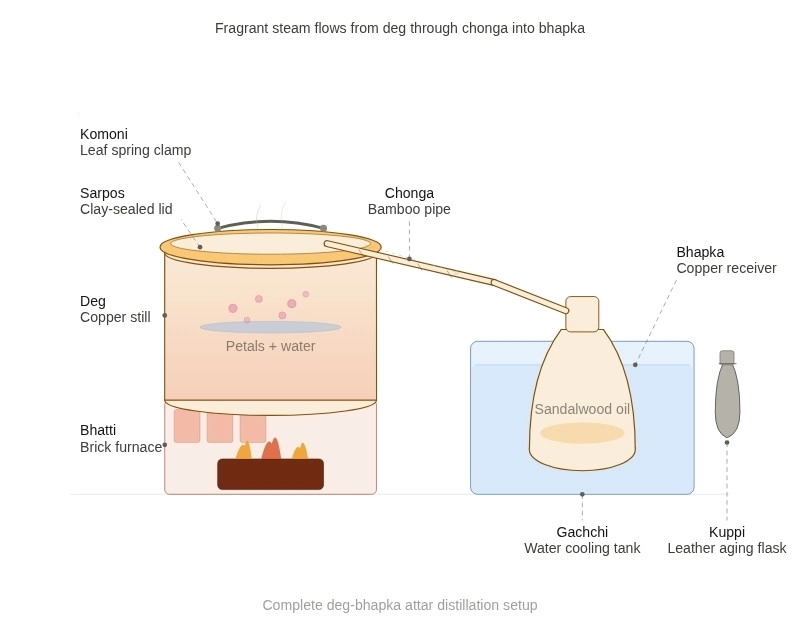
Here’s what you’re looking at inside a traditional Kannauj distillery:
The Deg — a large copper cauldron, handmade from thick-gauge copper sheet. You can see the hammer marks on its surface. It sits on top of its own brick-and-clay furnace called a bhatti. A single deg can hold 100 to 160 kg of botanical material plus water. This is where the flowers go.
The Sarpos — the lid. It gets sealed airtight with a paste made from wet clay, cotton fibers, and straw. No gaskets, no rubber seals. Just clay. A leaf spring called a komoni clamps the lid down to prevent it from blowing off under pressure during distillation.
The Chonga — a hollow bamboo pipe wrapped in grass rope for insulation. This connects the deg to the receiving vessel, carrying fragrant steam from one to the other. The angle is downward, so gravity helps the condensed vapors flow.
The Bhapka — the receiving vessel. Pear-shaped copper, with a large belly and a narrow neck. The name literally means “steam” in Hindi. Before distillation begins, the bhapka is charged with up to 5 kg of pure sandalwood oil. This is where the attar is born.
The Gachchi — a water-filled cooling tank. The bhapka sits submerged in this throughout distillation. The cool water condenses the incoming steam back into liquid as it enters the bhapka.
The Kuppi — a traditional leather flask, historically made from camel skin, now usually buffalo or lamb. Used for the final sedimentation and aging of the finished attar after distillation is complete.
That’s it. No motors. No gauges. No digital controls. Every piece is handmade, and most distilleries use equipment that has been repaired and reused for decades.
3.2 The daily cycle
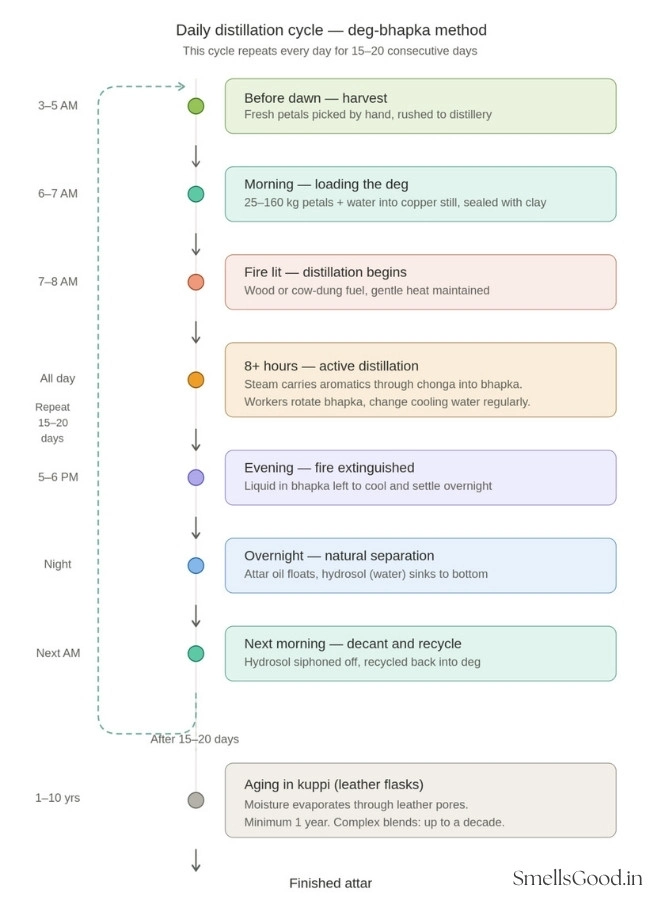
Here’s what happens on a typical day of attar distillation, from before sunrise to evening:
Before dawn: Freshly harvested petals arrive at the distillery. Speed matters. These flowers were picked hours ago, and their aromatic compounds are already starting to fade.
Loading the deg: The petals are loaded in — anywhere from 25 to 160 kg, depending on the botanical and the still’s size. Pure water is added so the flowers float freely. This ensures even extraction. You don’t want petals packed tight against the copper bottom where they’d scorch.
Sealing: The sarpos goes on. Clay paste is applied around every edge. The chonga is connected. The bhapka, already containing its charge of sandalwood oil, is lowered into the gachchi cooling tank.
Lighting the fire: The bhatti is lit, fueled by wood or dried cow-dung cakes. The heat has to be gentle and consistent. Too aggressive and you scorch the petals, destroying the delicate aromatic compounds. Too low and you don’t get enough vapor moving through the system.
The next 8+ hours: This is where the transformation happens.
As the water heats inside the sealed deg, three things occur simultaneously:
- Hydro-diffusion: Hot water penetrates the cell walls of the petals
- Rupture: Heat breaks open the tiny oil glands inside each petal, releasing hundreds of volatile aromatic compounds
- Vaporization: These aromatic molecules mix with the steam, rise through the deg, travel through the chonga, and enter the bhapka
When the fragrant steam hits the cool bhapka (chilled by the surrounding water in the gachchi), it condenses back to liquid. The aromatic molecules are immediately absorbed into the sandalwood oil waiting below.
Throughout the day, workers rotate the bhapka by hand to keep the oils blending and prevent localized overheating.
The cooling water in the gachchi is changed regularly to maintain condensation efficiency.
Evening: The fire is extinguished. The liquid inside the bhapka is left to cool and settle overnight. A natural separation occurs — the aromatic hydrosol (water) sinks to the bottom, and the attar oil floats on top.
Next morning: The hydrosol is carefully siphoned off. But it doesn’t get thrown away.
This is one of the most clever parts of the entire process. That hydrosol, now carrying dissolved aromatic compounds of its own, gets recycled back into the deg. Fresh flowers are added on top of it. And the whole cycle begins again.
3.3 The 15 to 20 day marathon
That daily cycle I just described? It repeats every single day for 15 to 20 consecutive days. Sometimes longer for complex botanicals.
Each day:
- Fresh flowers loaded
- Previous day’s hydrosol recycled back in
- Full 8+ hour distillation
- Overnight settling
- Morning decanting
With each cycle, the sandalwood oil in the bhapka absorbs more aromatic depth. It’s not a single extraction. It’s a layered accumulation of fragrance over weeks, each day adding another dimension.
By the final day, the sandalwood oil has been completely transformed. It has surrendered its own scent and fully acquired the character of the distilled flower.
Meanwhile, the repeatedly recycled hydrosol has become richly fragrant in its own right. This is sold separately as rose water or kewra water for culinary and skincare use. Nothing gets wasted.
3.4 After distillation: aging in leather
The raw attar coming out of the bhapka on day 20 is not the finished product. Not yet.
It gets poured into kuppi, those leather flasks. The leather’s pores are just open enough to let excess moisture slowly evaporate while keeping the precious oil inside.
The kuppis are placed in sunlight initially to speed up moisture loss, then moved to dark, dry rooms for maturation.
Minimum aging time: one year.
Complex blends like shamama? Years. Sometimes a full decade.
During aging, the aromatic compounds continue to integrate and mellow. Harsh edges soften. The fragrance becomes rounder, deeper, more unified.
Like wine, attar gets better with time, and each batch is unique, shaped by that year’s flowers, that season’s weather, and that particular craftsman’s hand.
3.5 The numbers that put it in perspective
This process produces tiny quantities. That’s not a flaw. It’s the nature of what’s being made.
For rose attar specifically:
- Roughly 3,000 to 5,000 kg of fresh rose petals yield just 1 kg of rose oil
- That’s approximately 50 kg of petals and 10,000 individual blossoms for about 10 ml of finished attar
- All picked by hand, before sunrise, and processed the same day
When you hold a small bottle of genuine rose attar and understand what went into it, the weeks of daily distillation, the thousands of hand-picked flowers, the year of aging, the price suddenly makes complete sense.
And when you apply a single drop to your wrist and watch it evolve over the next twelve hours, you’re experiencing something that no factory shortcut can replicate.
4. The Master Distiller — Why Human Senses Replace Modern Instruments
Everything I described in the previous section — the temperature control, the timing, the decision of when the attar has reached the right concentration — all of that is managed by one person’s senses.
No thermometers. No pressure gauges. No digital readouts.
The entire deg-bhapka process is governed by the digaha (sometimes called dighoo) — the master distiller. And his only instruments are his own hands, ears, nose, and decades of accumulated experience.
4.1 How a digaha reads the still
Temperature is read by touch. The digaha places his bare hands flat against the hot copper deg throughout the day, gauging whether the heat is too aggressive or too gentle.
Copper conducts heat beautifully, so the surface temperature tells him what’s happening inside the sealed vessel. He can’t see in there. He can’t check a display. He feels it.
Sound is diagnostic. The hiss and gurgle of steam passing through the chonga tells the craftsman about distillation rate and vapor quality.
A certain pitch means things are moving well. A change in sound means something needs attention.
When overheating is detected, wet towels are rubbed over the deg’s body to bring the temperature down.
When the desired concentration is reached, a wet towel wrapped around the deg signals completion.
That’s it. Hands on hot copper. Ears on steam. Wet cloth for temperature control.
4.2 The apprenticeship that takes a lifetime
Nobody walks into a Kannauj distillery and becomes a digaha. The learning path is measured in decades, not semesters.
A young apprentice begins with the basics. Chopping firewood. Mixing the clay paste for sealing lids. Carrying flowers. Cleaning equipment. He watches everything but controls nothing.
Over years, he’s gradually trusted with more. Maintaining the fire. Monitoring the cooling water. Assisting with the morning decanting.
Each step requires proving that his judgment can be relied on before he moves to the next.
Eventually, after years of daily observation, he begins judging temperatures by touch and concentrations by smell.
Some master distillers working in Kannauj today have 30 to 50 years of experience. One family claims an unbroken chain of 30 generations in the trade.
There are no written manuals for this. No certification programs. No YouTube tutorials that can substitute for a decade of standing next to a working still in the summer heat of Uttar Pradesh.
4.3 Why this matters beyond the romance
It’s easy to frame this as charming tradition. An old craft preserved by old men. Nice story.
But there’s something more practical going on.
The sensory monitoring produces results that automated systems don’t replicate. Each digaha’s hand, each craftsman’s instinct for when to push the heat and when to pull back, produces subtly different attars from the same flowers.
This is why two Kannauj distilleries using identical rose petals can produce attars with noticeably different characters. The human variable isn’t a bug. It’s the signature.
It’s also the craft’s greatest vulnerability.
When a master distiller retires, and his son chooses an IT job in Bangalore or a delivery gig in Delhi, that specific knowledge chain breaks permanently.
You can’t download it later. You can’t reconstruct it from documents that don’t exist.
Every digaha who walks away from the still takes something irreplaceable with him.
5. The Simple Science Behind Attar Distillation
You don’t need a chemistry degree to understand why the deg-bhapka method works. But knowing the basics changes how you think about the attar on your skin.
Three things make this process scientifically distinct from every other way of extracting fragrance from plants.
5.1 Why water contact captures what steam alone misses
The deg-bhapka method is technically called hydro-distillation. That means the plant material sits fully immersed in water inside the deg.
This is different from industrial steam distillation, where steam from a separate boiler gets forced through flowers sitting on a mesh.
The difference sounds small. It isn’t.
When petals sit in hot water, three things happen at the same time:
- Hydro-diffusion: Hot water physically penetrates the cell walls of the petals
- Rupture: Heat breaks open the tiny oil glands inside each petal
- Release: Hundreds of volatile aromatic compounds are freed and vaporize with the steam
Now here’s the key scientific principle that makes this whole thing possible.
Essential oils normally have boiling points well above 100°C. You’d think you’d need extreme heat to vaporize them.
But when they’re mixed with water, their partial pressures combine, allowing them to vaporize at much lower temperatures.
What this means in practice: heat-sensitive aromatic compounds get extracted gently, without the thermal degradation that higher-temperature industrial methods cause. Delicate molecules survive intact. The fragrance stays true to the flower.
There’s another advantage specific to water immersion. Take rose distillation as an example.
Phenylethyl alcohol, one of the molecules most responsible for that characteristic rose sweetness, is water-soluble. In steam distillation, it dissolves into the water and gets lost unless you add an extra recovery step called cohobation.
In the deg-bhapka method? It gets captured automatically.
Remember how the hydrosol is recycled back into the deg each morning with fresh flowers? That daily recycling naturally recovers water-soluble aromatics that steam-only methods miss. The process is slower, but it’s more complete.
5.2 Why copper isn’t just traditional — it’s chemically functional
Kannauj distillers didn’t choose copper because it looks good. They chose it, whether they knew the chemistry or not, because copper actively shapes the quality of the distillate.
Even heat distribution. Copper has excellent thermal conductivity. Heat spreads uniformly across the deg’s surface instead of creating hot spots that would scorch petals sitting near the bottom. For delicate flowers like rose and jasmine, this matters enormously.
Sulfur removal. This is the big one. During distillation, volatile sulfur compounds can create unpleasant “burnt” or “cabbage-like” off-notes. Copper reacts with these sulfur molecules, binding them as copper sulfide deposits on the still’s inner wall. They’re effectively filtered out of the distillate before they ever reach the bhapka.
Ester enhancement. Esters are the molecules responsible for fruity and floral notes in fragrance. Copper catalyzes their formation during distillation. Research on distillation chemistry shows copper stills retain up to 30% more ester compounds than stainless steel alternatives. More esters means a richer, more complex aromatic profile.
Aldehyde absorption. Copper also adsorbs harsh aldehydes that would otherwise make the distillate smell sharp or aggressive. The result is a smoother, mellower aromatic character overall.
So when you see those old, hammered-copper degs in photos of Kannauj distilleries, know that every dent and patina on that surface is doing actual chemical work.
The material isn’t nostalgic decoration. It’s a functional part of the fragrance.
Why the finished attar is fundamentally different from a blended perfume
This is the part worth sitting with for a moment.
In Western perfumery, a perfumer sits at an organ — a workstation lined with hundreds of bottles of separate essential oils, absolutes, and synthetic aroma chemicals.
They construct a fragrance by combining these pre-made ingredients in precise ratios. Top notes, heart notes, base notes — all assembled after the fact from components that were extracted independently.
In an attar, that assembly happens inside the still.
The floral top notes, the rich heart, and the warm sandalwood base are all built simultaneously over 15 to 20 days of co-distillation.
The molecules don’t just sit next to each other in a bottle. They’ve been integrating at the molecular level, through heat and steam and time, for weeks.
This is the fundamental difference. A blended perfume is an arrangement. An attar is a fusion.
And it’s the reason attar behaves differently on skin.
The scent doesn’t separate into distinct layers the way a constructed fragrance sometimes does. It unfolds as a unified whole, shifting gradually over hours rather than jumping from one note to another.
6. Types of Attar by How They’re Made
Not all attars are made the same way or from the same materials.
The Indian tradition produces a remarkable range, from single-flower extractions that capture one bloom’s pure essence to complex compound blends containing 60+ ingredients distilled over months.
Understanding the categories helps you know what you’re actually buying.
6.1 Single-flower attars
These are the purest expression of the craft. One flower. One sandalwood base. Weeks of patient distillation. Nothing else.
Gulab (rose) attar is the flagship of Indian perfumery. Soft, deeply romantic, calming. Classified as a “cool” fragrance in the Ayurvedic tradition, which makes it a summer attar.
The yield numbers are staggering. Roughly 50 kg of fresh rose petals, about 10,000 individual blossoms, produce approximately 10 ml of finished rose attar. That’s it.
Ten milliliters from ten thousand flowers.
Genuine sandalwood-based rose attar can cost up to ₹12 lakh per kilogram (roughly $14,500), and when you understand the math, that price isn’t inflated.
It’s just what the process demands.
Motia (jasmine sambac) attar is often called the “King of Flowers.” Intoxicating, sweet, deeply sensual. Made from night-blooming flowers that are picked before dawn, when their fragrance peaks.
Genuine traditional motia attar costs approximately $5,400 per liter.
If you’ve never smelled real jasmine sambac attar, the intensity compared to any jasmine perfume you’ve tried before will surprise you.
Kewra (screwpine) attar has a character unlike any other floral. Sweet, green, slightly aquatic, with notes of honey and hyacinth.
The production ratio is brutal: 10,000 to 15,000 flower spikes per pound of sandalwood oil. Nearly all of India’s kewra comes from Ganjam, Odisha.
Other single-flower attars worth knowing: chameli, juhi, kadam (associated with Lord Krishna in Hindu tradition), champaca, tuberose, lotus, and raat rani (night queen, named for its intense nighttime bloom).
Each one has its own season, its own regional source, and its own personality on skin.
Attar Yield Ratios and Prices
| Attar Type | Raw Material Needed | Approximate Yield | Price (genuine, sandalwood base) |
|---|---|---|---|
| Gulab (Rose) | ~50 kg petals / 10,000 blossoms | ~10 ml | Up to ₹12 lakh/kg (~$14,500) |
| Motia (Jasmine sambac) | Night-blooming flowers, picked predawn | Very low | ~$5,400/liter |
| Kewra (Screwpine) | 10,000–15,000 flower spikes | Per pound of sandalwood oil | Premium pricing |
| Mitti (Baked earth) | Kiln-fired clay discs, 15–60 days distillation | Small batches | ~₹1,80,000/liter (~$2,200) |
| Shamama (Compound) | 40–60+ ingredients, 2+ months production | Very small batches | Varies widely by recipe |
6.2 Compound attars — the complex blends
If single-flower attars are solo performances, compound attars are orchestras.
Shamama is the crown jewel. There’s nothing else like it in world perfumery.
A traditional shamama contains 40 to 60+ natural ingredients — herbs, spices, roots, flowers, resins, and woods.
Every Kannauj family that makes shamama guards its own recipe, passed down through generations. No two shamama attars smell identical.
The production is a multi-stage marathon lasting at least two months. Here’s how one reputed Kannauj distiller describes the sequence:
- Days 1–10: Himalayan lichen (charila) is hydro-distilled into sandalwood oil to create the aromatic foundation
- Next phase: Ground aromatic roots — spikenard, valerian, cyperus — are sequentially distilled in
- Then spices: Cinnamon, cardamom, mace, nutmeg, clove, patchouli, ambrette seed. Fresh material added daily.
- Optional stage: “Choyas” are introduced — materials created through dry distillation of charred seashells, frankincense, or sal tree resin. These add smoky, mineral depth.
- Heating phase: The crude oil is heated for 3 to 5 days with saffron and spice powders
- Resting and maceration: 15 to 20 days of quiet integration
- Final enrichment: Pre-distilled attars of rose, jasmine, kewra, and champaca are blended in
The result is warm, spicy, earthy, leathery, resinous, and tea-like all at once.
It’s a winter fragrance of extraordinary complexity. Wearing shamama in December is one of those experiences that makes you understand why people get obsessed with attar.
Hina attar is a related compound blend of 35 to 70+ ingredients, revered in Ayurveda as a warming fragrance designed to counterbalance cold, dry Vata dosha. Deep, herbal, grounding.
Majmua blends four pre-distilled attars together — vetiver, kewra, mitti, and kadam — into a lush, earthy, monsoon-evoking fragrance.
It’s widely applied before Islamic prayer, especially for Friday Jummah and during Ramadan.
6.3 Mitti attar: the perfume that smells like rain
This might be the most poetic attar in existence. And the most uniquely Indian.
Mitti attar captures petrichor, the scent of first rain falling on sun-baked earth.
That smell every Indian knows. The one that makes you stop and breathe in during the first monsoon shower.
Someone in Kannauj figured out how to put it in a bottle.
Only about 10% of Kannauj’s perfumeries produce it. The process is unlike any other attar because it starts not with flowers but with baked clay.
Here’s how it works:
Artisans collect unglazed clay from the Ganga’s banks and discarded kulhads (those small clay tea cups you see everywhere in India). The clay is shaped into discs and fired in a kiln. These baked clay “tikkis” are then loaded into the deg in place of flowers and distilled into sandalwood oil.
The distillation runs for 15 to 60 working days depending on desired intensity.
The result is a cool, earthy fragrance associated with the monsoon season. A liter of mitti attar sells for approximately ₹1,80,000 (about $2,200).
Here’s the irony that not many people know: the actual monsoon is the worst time to make mitti attar.
Wet earth lacks the concentrated mineral aromatics that build up in dry, sun-baked clay. You need the earth to have been scorched by months of heat before it carries that petrichor signature.
The rain unlocks the scent. The sun creates it.
6.4 Seasonal attars: the body-climate philosophy
This is something almost no international fragrance guide covers, but it’s central to how attars have been used in India for centuries.
The Indian attar tradition classifies fragrances by their perceived thermal effect on the body.
This isn’t marketing. It’s rooted in Ayurvedic dosha theory, where fragrance is understood to actively interact with your physiology.
- Cool attars for summer: rose, jasmine, kewra, vetiver, mitti. These are considered refreshing and calming. They’re meant to counterbalance the heat your body absorbs during hot months.
- Warm attars for winter: shamama, hina, musk, amber, saffron. These are believed to generate internal warmth. They’re applied during cold months to balance the body’s response to lower temperatures.
This seasonal rotation isn’t just aesthetic preference. It’s a therapeutic framework that treats fragrance as a form of daily wellness practice.
Living in Rajasthan, this isn’t abstract theory for me. I rotate attars seasonally, and the difference is tangible.
A vetiver or mitti attar in peak May heat genuinely feels cooling on skin. Not temperature-cooling, but something calmer, lighter, more settled.
Shamama in December does the opposite — it feels warming, grounding, almost like wrapping yourself in something dense and rich.
Whether that’s the Ayurvedic framework at work or just the psychological effect of matching scent to season, I honestly can’t say. But the experience is real, and it’s one of the things that makes attar more interesting than anything in a department store fragrance aisle.
Related: For practical tips on getting the most out of your attar, read our How to Apply Attar So It Actually Lasts All Day guide.
7. How Traditional Attar-Making Compares with Modern Extraction Methods
The deg-bhapka method isn’t the only way to extract fragrance from plants. It’s not even the most efficient way.
But it produces something fundamentally different from every modern alternative.
Understanding the comparison helps you appreciate what you’re getting when you choose a traditionally made attar over a steam-distilled essential oil or a lab-extracted absolute.
7.1 Steam distillation — the global industrial standard
This is how most essential oils in the world are made. Lavender, eucalyptus, tea tree, peppermint — almost all of them come from steam distillation.
The setup is different from deg-bhapka. Instead of immersing flowers in water, the plant material sits on a mesh or grate inside the still. Steam from a separate boiler is forced through the material under pressure.
It’s fast. A typical batch takes 60 to 105 minutes. Compare that to the 15-to-20-day cycle of deg-bhapka.
The trade-offs are real, though. Higher temperatures and pressure can destroy heat-sensitive aromatic compounds. And water-soluble molecules like phenylethyl alcohol (crucial to rose’s sweetness) often get lost in the process unless an extra recovery step called cohobation is added.
Steam distillation is excellent for hardy botanicals. For delicate flowers like rose and jasmine, it captures a version of the scent. Not the full picture.
7.2 CO₂ supercritical extraction — the high-tech option
This is the most advanced method available.
Carbon dioxide is pressurized until it enters a “supercritical” state — simultaneously liquid and gas — and used to dissolve aromatic compounds from plant material.
The temperatures involved are low, just 35 to 60°C, which means heat-sensitive molecules survive beautifully.
Research shows lavender processed this way retains 95% of its linalool compared to about 80% with steam distillation. It also leaves zero solvent residue and captures both volatile and non-volatile compounds.
The problem is cost. A commercial-scale CO₂ extraction plant requires approximately €5.4 million in capital expenditure.
It’s technology suited to large industrial operations, not a family-run distillery in Kannauj with a brick furnace and a bamboo pipe.
7.3 Solvent extraction — for flowers too delicate for heat
Some flowers — jasmine, tuberose, mimosa — are so delicate that even gentle steam damages their aromatic profile. Solvent extraction is the answer.
The plant material is washed with a chemical solvent, usually hexane, which dissolves the aromatic compounds and produces a waxy substance called a “concrete.” This concrete is then washed with alcohol to yield an “absolute” — a highly concentrated aromatic extract.
The results can be excellent. Jasmine absolute is considered one of the most beautiful materials in all of perfumery.
But there’s always the risk of trace solvent residues in the final product, which matters if purity is important to you.
Extraction Method Comparison
| Feature | Deg-Bhapka (Traditional) | Steam Distillation | CO₂ Supercritical | Solvent Extraction |
|---|---|---|---|---|
| Time per batch | 15–20 days | 60–105 minutes | Hours | Hours |
| Temperature | Low, atmospheric | Higher, pressurized | 35–60°C | Room temp to moderate |
| Heat-sensitive compounds | Preserved (gentle process) | Some destroyed | Excellently preserved | Preserved |
| Water-soluble aromatics | Captured via hydrosol recycling | Often lost without cohobation | Captured | Not applicable |
| Base oil integration | Direct — distilled INTO sandalwood | Extracted separately, blended later | Extracted separately | Extracted separately |
| Solvent residue risk | None | None | None | Possible (hexane traces) |
| Capital cost | Low (handmade copper equipment) | Moderate | ~€5.4 million | Moderate |
| Final product | Finished perfume (attar) | Essential oil (needs blending) | Extract (needs blending) | Absolute (needs blending) |
7.4 What makes deg-bhapka fundamentally different from all of these
Here’s the critical distinction that separates the Indian method from every modern technique:
In every other method, the essential oil or extract is obtained first, and then blended with carriers or solvents afterward. Extraction and formulation are two separate steps.
In deg-bhapka, distillation happens directly into the base oil. The aromatic vapors condense into sandalwood oil as they arrive in the bhapka. There is no intermediate step. No separation and reassembly.
The flower and the base meet in the moment of creation, not on a perfumer’s workbench hours or weeks later.
Add to that:
- 15 to 20 days of slow, repeated cycles with fresh flowers daily
- Atmospheric pressure rather than forced steam
- Direct water contact that captures water-soluble aromatics naturally
- Human sensory monitoring adjusting the process in real time
The result is an aromatic complexity that post-production blending cannot replicate.
You can take the same rose essential oil extracted by steam distillation, add it to the same sandalwood oil, mix them perfectly, and the product will not smell like a traditionally distilled rose attar.
The molecular integration that happens over weeks inside a copper still creates something that assembly after the fact cannot reproduce.
The attar is the finished perfume. Created entirely within the still. Not assembled afterward from separate bottles.
8. How to Tell Real Attar from Fake
I want to be honest about something before getting into the tests and indicators.
The attar market is a mess.
Roughly 90% of Kannauj’s total output now uses paraffin or synthetic bases instead of sandalwood. The old 80:20 sandalwood-to-paraffin ratio has flipped to approximately 10:90.
Labels that say “natural attar” don’t guarantee a sandalwood base.
True sandalwood-based attars are now produced only on special order for buyers who specifically request them and are willing to pay the real price.
This doesn’t mean every affordable attar is garbage. Some paraffin-based attars use genuine floral distillates and smell perfectly decent.
But if someone is selling you “pure natural sandalwood-based attar” for ₹200 a bottle, you’re not getting what the label says.
You can’t. The math doesn’t allow it.
Here’s how to evaluate what you’re actually buying.
8.1 The scent evolution test (most reliable)
This is the single best way to judge an attar without any equipment. It just requires patience.
Apply a small drop to your inner wrist. Then check it at three points: 30 minutes, 2 hours, and 6 hours.
A genuine natural attar will change. At 30 minutes, you’ll get the bright, volatile top notes — the first impression.
At 2 hours, the heart emerges — richer, fuller, more complex.
By 6 hours, you’re in the base — warm, deep, woody, intimate. The fragrance tells a story over time. It moves.
A synthetic or heavily adulterated attar stays flat. Same smell at minute one as at hour five. No arc. No development. No surprise.
It might smell pleasant enough, but it smells like a photograph of a flower rather than the flower itself.
I’ve tested this more times than I can count in Jaipur.
Two attars from different shops, both labeled “rose attar,” both roughly the same color. One unfolds across an entire afternoon in 40-degree heat. The other just… sits there.
That unfolding is what you’re paying for when you buy the real thing.
8.2 The texture test
Put a drop between your fingertips and rub gently.
Pure attar on a sandalwood or quality natural base feels light.
It absorbs into skin relatively quickly without leaving a heavy residue. Your fingers feel soft afterward, not coated.
Attar on a paraffin or DPG base feels noticeably greasy or sticky.
There’s a slick, oily film that lingers. It sits on the surface of your skin rather than absorbing. If your fingers feel like you just touched cooking oil, that’s your answer.
8.3 The longevity pattern
This is related to the scent evolution test but focuses on duration and how the fragrance fades.
Natural attar on a good base: Lasts 8 to 24 hours depending on the type and your skin. The fade is graceful — a slow, gentle arc from bright to warm to a soft whisper close to skin. Even at the end, there’s something still there when you bring your wrist close to your nose.
Cheap synthetic attar: Two patterns. Either it fades within 30 to 60 minutes, and you’re left with nothing, or it persists at the same intensity for hours with zero evolution and then cuts off abruptly. Neither of these is how natural aromatic molecules behave on warm skin.
8.4 The price reality check
This isn’t a test so much as basic math.
Some reference points:
- Genuine sandalwood oil: over ₹1,00,000 per kg
- Genuine sandalwood-based rose attar: up to ₹12 lakh per kg
- Genuine mitti attar: roughly ₹1,80,000 per liter
- Genuine motia (jasmine sambac) attar: approximately $5,400 per liter
Now look at that ₹150 bottle of “pure rose attar” on a marketplace listing. The sandalwood oil alone in a single milliliter would cost more than the entire bottle.
The price is telling you what the product is. You just have to listen.
This doesn’t mean expensive automatically equals authentic. Overpriced synthetics exist, too.
But cheap always means compromised. There are no exceptions to this.
8.5 The blotting paper test
Simple and quick. Place a single drop of attar on clean white blotting paper or plain printer paper.
Natural attar leaves a faint, aromatic oil stain that lingers for hours. The scent on the paper will evolve just like it does on skin (though less dramatically).
The spot stays translucent and oily without spreading much.
Adulterated attar does one of two things. It either evaporates quickly (indicating alcohol or volatile solvents have been mixed in) or it spreads into a wide, greasy halo with a chemical undertone (indicating heavy synthetic carriers).
This isn’t a definitive lab test. But it catches the obvious fakes.
8.6 For absolute certainty: GC-MS testing
If you’re spending serious money — buying in bulk, sourcing for a business, or building a collection of high-end attars — the only way to know exactly what’s in a bottle is gas chromatography-mass spectrometry (GC-MS) analysis.
This lab test identifies every chemical compound in a sample and its concentration.
It can tell you definitively whether an attar contains genuine Rosa damascena distillate or synthetic rose oxide, whether the base is sandalwood or paraffin, and whether any adulterants are present.
It’s not cheap, and it’s not casual. But for high-value purchases, it’s the only test that removes all ambiguity.
Real vs Fake Attar Quick Checklist
| Test | Genuine Natural Attar | Synthetic/Adulterated Attar |
|---|---|---|
| Scent at 30 min | Bright, volatile top notes | Same as opening |
| Scent at 2 hours | Richer, fuller heart emerges | Still the same |
| Scent at 6 hours | Warm, deep base notes | Still the same, or gone |
| Texture on skin | Light, absorbs quickly | Greasy, sticky, sits on surface |
| Longevity | 8–24 hours, gradual arc | Fades in minutes OR persists without change |
| Blotting paper | Faint aromatic stain, lingers for hours | Evaporates fast OR spreads into greasy halo |
| Price (rose attar) | ₹3,000–5,000+ for 2.5 ml | ₹150–300 for a full bottle |
8.7 The honest bottom line
The attar world exists on a spectrum.
At one end, you have genuine, sandalwood-based, traditionally distilled attars that are extraordinary and expensive.
At the other end, you have fully synthetic fragrances marketed as “attar” that cost almost nothing to produce.
Most of what’s sold falls somewhere in the middle.
Genuine floral distillates on synthetic bases. Partial natural blends stretched with cheaper materials. Not outright fake, but not what the label implies either.
The best approach isn’t paranoia. It’s education.
Know what real attar costs. Know how it behaves on skin. Buy from reputed sources, start small, and let your own nose build the pattern recognition over time. The more real attar you smell, the easier it gets to spot what isn’t.
9. Kannauj — India’s Perfume Capital for Over 1,000 Years
The city where most of what I’ve described in this guide actually happens is Kannauj, a small city in Uttar Pradesh with a population of around 125,000.
It doesn’t look like a perfume capital. No gleaming factory campuses. No luxury brand headquarters. Just narrow lanes, old havelis, and copper stills tucked behind modest storefronts.
But this city has been the center of Indian perfumery for longer than Grasse has been the center of European perfumery. By over two centuries.
9.1 The ancient roots
India’s relationship with fragrance goes back further than most people realize.
Archaeological excavations from the Indus Valley Civilization (around 3000 BCE) have unearthed terracotta distillation apparatus. That’s 5,000 years ago.
Italian archaeologist Dr. Paolo Rovesti documented these findings, suggesting that some form of distillation knowledge existed in the Indian subcontinent millennia before it appeared anywhere else.
The Rig Veda references perfumed ointments. The Kamasutra lists perfume-making as one of the 64 arts a cultured person should master. Kautilya’s Arthashastra catalogs fragrant materials, including sandalwood and agarwood.
But the most remarkable ancient reference comes from Varahamihira’s Brhat Samhita, written in the 6th century.
It dedicates an entire chapter to perfumery, recording over 1,000 cosmetic combinations containing sandalwood. Through permutation of his listed formulas, 36,288 varieties of perfumes were theoretically possible.
Sixth century. 36,000 perfume varieties. That’s the depth of the tradition Kannauj inherited.
9.2 How Kannauj became the center
Kannauj’s rise as a perfume city happened during the Gupta period (4th to 6th centuries CE), but it reached full prominence when Emperor Harshavardhana made it his capital in 606 CE.
He renamed the city Kusumpura — City of Flowers.
The location was perfect. Kannauj sits in the fertile Ganges alluvial plain, ideal for growing fragrant flora. Roses, jasmine, and other aromatics thrived in the soil and climate.
The city’s position along ancient trade routes connected it to markets across the subcontinent and beyond.
The Chinese pilgrim Huan Tsang, who visited during Harshavardhana’s reign, documented widespread perfume use across North India.
Fragrance wasn’t a luxury reserved for royalty. It was woven into daily life.
9.3 The Mughal golden age
If the Gupta period established Kannauj, the Mughal era made it legendary.
Emperor Akbar established a dedicated Khusbhu-Khana (perfume department) and commissioned attar production from Kannauj’s craftsmen. His court historian Abu’l-Fazl chronicled the emperor’s daily attar use in the Ain-i-Akbari.
The most famous origin story in Indian perfumery comes from this period.
Asmat Begum, mother of Empress Nur Jahan, is credited with discovering rose oil after noticing an oily film floating on rose-petal-infused water that had been heated by the sun.
Nur Jahan went on to popularize and refine the distillation of Ruh Gulab (rose essence).
Emperor Jahangir wrote of rose attar with the kind of reverence most rulers reserved for military victories or architectural achievements.
The Nawabs of Awadh continued this obsession. Ghazi-ud-Din Haidar Shah famously maintained perpetually flowing attar fountains around his bedchamber.
Not water fountains scented with attar. Fountains of attar itself.
9.4 A fragrance that crosses every faith
One of the most remarkable things about attar in Indian culture is that it belongs to no single religion. It sits at the intersection of multiple faith traditions, revered by all of them.
In Islam, attar holds special significance because it contains no alcohol, making it halal.
Wearing fragrance is considered Sunnah — a practice recommended by the Prophet Muhammad. Attars like majmua and shamama are commonly applied before Namaaz (prayer), especially on Fridays.
The great Sufi poet Farid al-Din was literally named “Attar” — the perfumer — and used fragrance as a recurring metaphor for spiritual transcendence.
In Hinduism, attars serve as sacred offerings to deities.
Different fragrances are associated with different gods — Lord Vishnu with lotus, kewra, and chameli.
Lord Krishna with kadam. Sandalwood attar is everywhere in temple worship and meditation. The Ashtagandha tradition lists eight sacred fragrant substances used in rituals.
In Ayurveda, attars are therapeutic tools. Jasmine-sandalwood blends for Vata types. Rose-vetiver for Pitta. Lighter citrus-infused attars for Kapha.
Fragrance isn’t decoration. It’s medicine for the doshas.
Attar shows up at every major milestone of Indian life. Applied as a blessing at weddings. Offered at funerals. Exchanged during festivals.
When Prime Minister Modi hosted the G20 Summit in 2023, he gifted world leaders traditional Kannauj attars of mitti and gulab.
Not many products can claim genuine cultural significance across Hinduism, Islam, and Ayurveda simultaneously. Attar can.
9.5 A fact worth knowing
Kannauj was producing attar more than 200 years before Grasse, France emerged as Europe’s perfume capital.
The two cities recognized this shared heritage by signing a Twin City agreement in 2016, with plans for an International Perfume Park and Museum in Kannauj. The park is under construction, though progress has been slow.
Still. The acknowledgment matters.
India’s contribution to world perfumery didn’t start with modern niche brands discovering oud. It started in Kannauj, centuries before anyone in Europe knew what distillation was.
10. Why This Ancient Craft is Fighting to Survive
Everything I’ve described in this guide — the copper stills, the predawn harvests, the 20-day distillation cycles, the master distillers reading temperature through bare hands — all of it is under threat.
Not from a single catastrophe. From a slow accumulation of pressures that have been squeezing Kannauj’s attar industry for decades.
The sandalwood crisis is the most visible problem. But it’s not the only one.
10.1 The broader economic collapse
1991 changed everything
India’s economic liberalization opened the market to cheap, mass-produced, alcohol-based imported perfumes.
Suddenly, a consumer who had always worn attar could buy a spray-on fragrance for a fraction of the price.
It didn’t last as long. It didn’t have the depth.
But it was convenient, modern, and heavily marketed.
The numbers since then have been brutal.
Synthetic competition
A bottle of synthetic rose fragrance oil costs roughly $8. Ten milliliters of genuine Rosa damascena oil costs around $250.
That’s not a pricing gap. That’s a different universe.
The industry reportedly loses 15 to 20% of market share annually to cheaper synthetic alternatives.
Margin collapse
Profit margins for traditional attar makers have cratered from a historical ~900% to just 10 to 20%.
The cost of raw materials, especially sandalwood, has skyrocketed while the market price consumers are willing to pay hasn’t kept up.
The tobacco problem
This is the one that surprises most people.
Approximately 90% of Kannauj’s total attar output now goes to flavoring tobacco and pan masala products, not personal perfumery.
The fragrance capital of India has become, in economic reality, a supplier to the tobacco industry.
It pays the bills. But it’s a far cry from what the craft was built for.
Worker wages
The people who actually tend the stills, load the flowers, and maintain the fires earn roughly ₹2,500 per month.
For physically demanding, highly skilled work in summer heat that regularly exceeds 40°C.
At that wage, the next generation’s calculation is obvious. An IT job in Bangalore. A delivery gig in Delhi. Anything but the still.
The distillery count tells the story most clearly
At its peak, Kannauj had over 700 distilleries. Today, approximately 350 manufacturing units remain.
And the number of those still practicing genuine traditional deg-bhapka distillation with a sandalwood base is far smaller.
Many of the surviving units have diversified into unrelated businesses, cold storage for potato farmers, for instance, to stay afloat.
10.2 What’s being done to save it
The picture isn’t entirely bleak. There are people and institutions actively working to keep this craft alive. Some of the efforts are promising. Some are slow. All of them matter.
New-generation entrepreneurs are the most visible sign of hope.
Boond Fragrances, founded in 2021 by siblings Krati and Varun Tandon, combines traditional deg-bhapka methods with contemporary branding — clean bottles, poetic descriptions, the GI tag featured prominently — and sells through Amazon.
They’re proving that a Kannauj attar brand can reach modern consumers without abandoning the traditional process.
Kannauj Attar (Ancient Fragrances), tracing its founding to 1872, has restructured as a direct-to-consumer brand exporting to 50+ countries under its 5th-generation leadership.
Other heritage houses — M.L. Ramnarain, Devi Prasad Sundar Lal Khatri — continue traditional production while building international market access.
Government and institutional support is present, though uneven.
Kannauj Perfume received a GI (Geographical Indication) tag in 2014, legally protecting its origin identity the way Champagne protects French sparkling wine.
The ODOP (One District One Product) scheme provides subsidized packaging and e-commerce training.
The FFDC (Fragrance and Flavour Development Centre), a central government research center in Kannauj established in 1991, has developed fuel-efficient distillation units that save up to 48% on fuel costs — a meaningful reduction for small distillers burning wood and cow-dung cakes daily.
A 50-acre Perfume Park with museum, hotel, and common facilities is under construction.
Progress has been slow, but the intent is to position Kannauj as a global fragrance tourism destination.
International interest is growing from unexpected directions.
Major Western perfume houses including Dior and Hermès are increasingly sourcing from Kannauj.
There’s a documented shift in global luxury fragrance toward eastern ingredients — oud, rose, sandalwood, musk — and Kannauj’s traditional craftsmen are uniquely positioned to supply what machines can’t replicate.
The Middle East remains the largest export market, driven by Islamic preference for alcohol-free fragrances.
India exports fragrance and flavor materials worth over $500 million annually, and the global halal fragrance market, valued at over $50 billion, represents a significant opportunity for traditional alcohol-free attars specifically.
10.3 The real question
The demand exists. It’s growing, in fact, from Gulf markets to Western luxury houses to eco-conscious consumers rediscovering natural perfumery.
The question isn’t whether people want real attar. They do.
The question is whether the irreplaceable elements can be sustained long enough for that demand to matter.
The sandalwood trees that take 50 years to grow. The master distillers whose knowledge exists nowhere except in their own hands and memory. The willingness to spend 20 days making what a machine can approximate in 20 minutes.
You can’t fast-track a sandalwood tree. You can’t download a digaha’s 40 years of sensory training. You can’t industrialize a process whose entire value lies in its slowness.
What you can do, as someone who wears attar, is make informed choices.
Know what’s real. Be willing to pay for it.
Understand that when a small Kannauj distiller charges ₹3,000 for a 2.5ml bottle, that price isn’t greed. It’s survival.
What a Single Drop Actually Represents
I want to end this guide where it started. With a drop of attar on your wrist.
But now you know what went into it.
You know that someone woke up before sunrise and picked those flowers by hand in the dark.
That the petals reached a copper still within hours, because every minute of delay meant lost fragrance.
That a craftsman sealed the still with clay, lit a wood fire, and spent the next eight hours reading temperature through his bare hands on hot copper.
You know that this happened every day for two to three weeks straight.
Fresh flowers each morning. The same fire. The same hands. The same patient accumulation of scent into sandalwood oil.
You know the sandalwood itself came from a tree that took half a century to mature.
That those trees are nearly gone now, and the ones that remain are fought over.
You know the finished oil was poured into a leather flask and aged for a year or more before anyone considered it ready.
For rose attar specifically, the math comes down to this: 10,000 hand-picked blossoms for roughly 10 ml of oil.
That’s what sits in the small bottle.
And you know the tradition behind it stretches back over a thousand years.
That it crosses every major Indian faith. That it survived Mughal empires and British colonization and economic liberalization and the arrival of cheap synthetic alternatives.
That it’s still here, but barely, practiced by fewer families each decade, in a small city most people have never heard of, using equipment that hasn’t fundamentally changed in centuries.
The attar industry doesn’t need sympathy. It needs informed buyers.
People who understand the difference between a ₹200 synthetic and a ₹3,000 genuine article.
People who know that when an attar evolves on their skin across twelve hours, that arc was built over weeks inside a copper still by a craftsman whose family has been doing this for generations.
People who are willing to pay the real price for the real thing.
That’s what this guide was for.
Not to make you an expert in distillation chemistry. But to make you the kind of person who picks up a bottle of attar and actually understands what you’re holding.
The next time you apply a drop, give it a few hours. Watch it change. Feel it warm on your skin and shift from bright to deep to soft.
That slow unfolding isn’t a feature of the fragrance.
It’s the entire point.
FAQs
How long does it take to make attar?
Traditional attar takes 15 to 20 days of daily distillation using the deg-bhapka method, followed by a minimum one year of aging in leather flasks. Complex blends like shamama take two months or more to distill.
Why is attar so expensive?
The yield is tiny — roughly 10,000 hand-picked rose blossoms produce just 10 ml of attar. The sandalwood oil base alone costs over ₹1,00,000/kg, and the distillation process runs daily for weeks, tended by a master craftsman.
What is the deg-bhapka method?
Deg-bhapka is the traditional Indian copper-still distillation technique. Flowers are heated in water inside a copper deg, and the fragrant steam travels through a bamboo pipe into the bhapka (receiver) where it’s absorbed directly into sandalwood oil. The cycle repeats daily for 15 to 20 days.
Why is sandalwood used in attar?
Sandalwood oil acts as a natural fixative. Its heavy molecules bind to lighter floral compounds, slowing their evaporation and extending fragrance life on skin from minutes to hours. Attars on a sandalwood base can improve with age for up to 10 years.
How can you tell if attar is real or fake?
Apply a drop to your wrist and check at 30 minutes, 2 hours, and 6 hours. Genuine attar evolves through distinct top, heart, and base notes. Synthetic attar smells the same at every stage, often feels greasy, and is priced suspiciously low.
What is mitti attar made from?
Mitti attar is made from baked clay, not flowers. Kiln-fired clay discs from the Ganga’s banks are distilled into sandalwood oil for 15 to 60 days, capturing the scent of petrichor — first rain on sun-baked earth.
How much rose is needed to make attar?
Approximately 50 kg of fresh Damask rose petals — around 10,000 individual blossoms, all hand-picked before sunrise — yield roughly 10 ml of finished rose attar.
What is shamama attar?
Shamama is a complex compound attar containing 40 to 60+ natural ingredients — herbs, spices, roots, flowers, resins, and woods — distilled in multiple stages over at least two months. It’s a warm, spicy, earthy winter fragrance, and every Kannauj family guards its own recipe.
Is attar making dying out?
It’s under serious threat. Kannauj’s distilleries have dropped from 700+ to roughly 350, sandalwood costs have risen 2,000% in two decades, and most young workers are leaving for city jobs. But new-gen brands, the 2014 GI tag, and growing international demand from luxury houses and halal markets offer some hope.